“World trade remains dangerously dependent on a handful of shipping lanes” by Ferdinand Rauch, Stephan Maurer, and Luke Heath Milsom, originally published on LSE Blogs, licensed under CC BY 4.0.
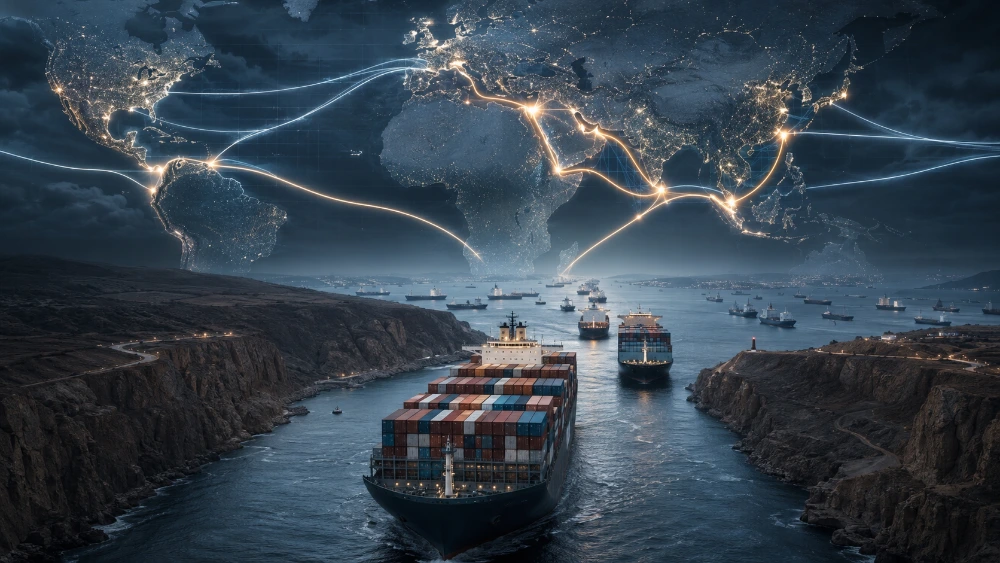
Despite the digitisation of the global economy, world trade is still only as resilient as the physical routes it depends on. Around 90 per cent of freight still travels by sea. Yet despite this reliance on waterways, the shipping network does not always run smoothly. Traffic between regions is often forced through small number of pinch points including straits or canals. When these are disrupted, the consequences can be significant.
After the container ship Ever Given ran aground and blocked the Suez Canal, in Egypt, for six days in March 2021, the World Trade Organisation estimated that the stoppage knocked somewhere between $6 billion and $10 billion off global trade volumes. The stoppage made headlines and rattled stock markets and inspired countless memes.
Many of the arteries that carry the bulk of world trade are vulnerable in other ways. Attacks by Houthi rebels on shipping in the Red Sea regularly disrupt that route. Drought has led to reduced water levels and restrictions the size of ships that can pass through the Panama Canal. And the closure of the Strait of Hormuz during the ongoing war between American and Iran has contributed to both an energy crisis and increased inflation in much of the world.
In a new working paper, we compare quantitatively, for the first time, just how exposed trade is to several key waterways.
Modelling a World Without Its Shortcuts
Using the gravity model of trade we measured sea routes between 455 ports with a statistical trade model that lets us simulate what would happen if a major route closed, or if a new one opened.
We simulate shutting three shipping lanes: the Panama Canal (which connects the Caribbean Sea with the Pacific Ocean), the Suez Canal (between the Red Sea and the Mediterranean Sea) and the Strait of Malacca (between the Indian Ocean and the South China Sea).
We also looked at opening two new routes: a year-round Northwest Passage (connecting the Atlantic and Pacific oceans through the Arctic north of Canada) and a proposed canal across Thailand’s Kra Isthmus. (This scheme would lower the distance for many shipment routes between China or Japan and Europe, although the Thai government is reported to be considering a land-bridge project instead of a canal.)
Both Canals Matter, a Lot
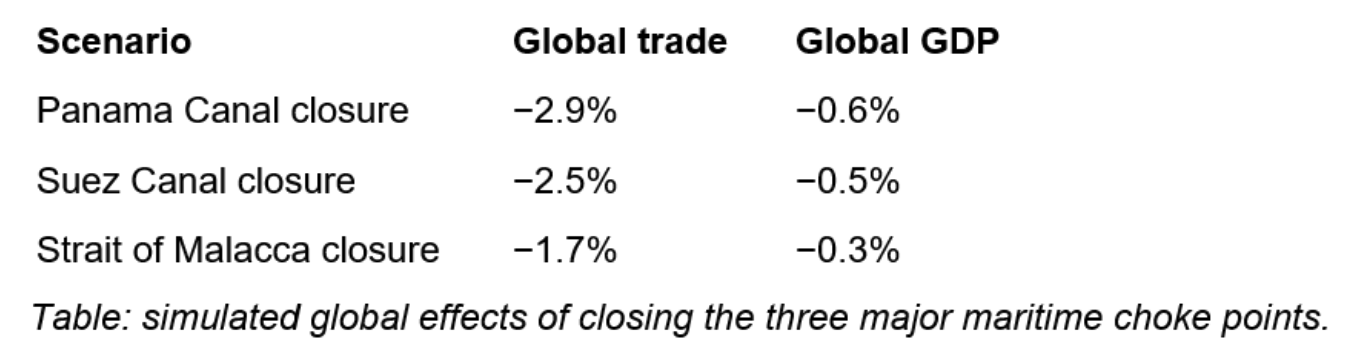
Our numbers show a similar disruption potential for all three major waterways we examine. A permanent closure of Panama would cut global trade by about 2.9 per cent; closing Suez would cost the world 2.5 per cent; and closing Malacca would cost 1.7 per cent.
Each is important enough, on its own, to inflict damage to global trade on roughly the same order of magnitude. But substitutability is also relevant. If Suez closed, ships could still reach Asia from Europe by sailing around the South Africa’s Cape of Good Hope. This route is longer and costlier, but also well-established.
Losing Panama is somewhat more damaging in relative terms: it severs the link between America’s Atlantic and Pacific coasts, necessitating a very lengthy detour around the southern tip of South America.
From Trade to Living Standards
Lost trade is not an abstract number. It also leads to lower overall GDP. Our model translates the Panama scenario into an immediate 0.6 per cent hit to world GDP, with Suez costing 0.5 per cent and Malacca 0.3 per cent. These figures capture the moment just after a closure, before firms and shippers have had time to adjust. Over the longer term, the losses are likely to reduce as the system will find workarounds.
The global averages disguise substantial variation across countries. For the United States, the Panama Canal is critical for connecting its east and west coasts: a closure would cut American trade by more than 10 per cent. China, by contrast, would barely notice, with a marginal trade drop of 0.1 per cent.
Perhaps unsurprisingly, China’s vulnerability lies in the Strait of Malacca. This is the chokepoint through which much of its energy imports and manufactured exports must pass. Our model has Chinese trade falling by 2.3 per cent if that closed.
For Europe, Suez is the binding constraint. A closure would cut Greek trade by more than 8 per cent and Romanian trade by over 7 per cent, with Italy losing around 5 per cent.
But it is the countries that border these routes which are hit hardest of all. If Suez closed Egypt would lose over 40 per cent of its trade and roughly 8 per cent of its entire GDP. When we use a model-driven measure of national welfare, which is broader than mere GDP and trade flows, Mexico and Panama each lose around 4 per cent in the Panama scenario, Qatar loses almost 3 per cent in the Suez scenario, and Malaysia loses nearly 4 per cent if Malacca closes.
Does the Model Match Reality?
Trade statistics are published with a lag, which makes it hard to test a model like ours against real-world events as they happen. But financial markets react in real time. We compared our model’s predictions with how stock markets in 15 countries actually moved while the Ever Given blocked Suez.
We found that countries that are more exposed to the Suez route according to our model did tend to see sharper market falls during the blockage. However with only 15 countries in the comparison, and India exerting an outsized pull on the result we would flag this as suggestive rather than conclusive evidence.
New Routes Are a Slow Burn, Not a Quick Win
If closures are costly, do new waterways boost trade? According to our results, the answer is not by much, at least not immediately. Opening a Kra Canal would raise global trade by only 0.7 per cent; a fully navigable Northwest Passage would add just 0.6 per cent.
The modest figures reflect how deeply path-dependent shipping networks are. Ports, fleets and supply chains have spent decades organising themselves around the routes that already exist, so a new shortcut starts out serving only a narrow slice of traffic. But while a closure does its damage immediately and the cost fades over time as the system adapts, opening works the other way round – gains are small on day one and grow over decades, as industrial clusters and trading relationships gradually adjust and new trade infrastructure sets up along the route.
So new routes could end up mattering far more as insurance against future disruption elsewhere than as growth engines in their own right.
Supply Chains Make the Costs Bigger Still
Our headline estimates do not reflect the full impact of closures. When we extend the model to account for the way disruptions ripple through global supply chains — drawing on a methodology developed for solving gravity models — the estimated welfare losses from a chokepoint closure are found to be 50 per cent higher than in our simple baseline.
This is because much of the true cost of these disruptions comes not from the direct loss of trade itself, but from the subsequent damage to production chains upstream. This finding is particularly important for those industries that have built their supply chains around the assumption that goods will always get through.
What This Means for Policy
Our study finds not that one canal is more important than another, but that world trade remains highly dependent on a small number of locations. That matters for policy in four ways.
Having a number attached to the risk lets governments and firms weigh the cost of securing a route against the cost of leaving it exposed. It quantifies to America and China why Panama and Malacca are so critical for their economic security.
New routes through the Arctic or a Kra Canal are unlikely to transform global trade flows quickly but could offer welcome insurance against problems elsewhere.
Because the sharpest losses come in the immediate aftermath of a shock, before adjustment mechanisms can kick in, building resilience through diversified suppliers and flexible logistics matters more than waiting for alternative routes to appear as substitutions.
And finally, since a substantial share of the ultimate cost is transmitted through supply chains rather than trade volumes directly, resilience planning should look beyond the route itself to the production chains that depend on it.
This article summarises The Fragility of the Global Trading System, a CEP discussion paper published in May 2026.
About the authors:

Ferdinand Rauch
Ferdinand Rauch is Professor of Economics at the University of St Gallen in Switzerland. He is an Associate at the Centre for Economic Performance. His research fields include Urban Economics, International Economics and Economic History.

Stephan Maurer
Stephan Maurer is a Ramón y Cajal Researcher at the UPF Barcelona School of Management and an Associate in the Centre for Economic Performance’s Labour Programme. His research fields include Economic History, Labour Economics, Urban Economics, International trade, and Political Economy.

Luke Heath Milsom
Luke Heath Milsom is assistant professor of economics at KU Leuven, and an associate at the Institute for Fiscal Studies. His research focuses on questions relating to urban and spatial economics, development economics, and labour economics.