For decades, most businesses have followed the same blunt formula: take raw materials, make products, sell them, and let somebody else worry about the rubbish. It’s the industrial equivalent of eating the meal, leaving the plates on the table, and walking off as if the washing-up fairy will sort it out. That linear model helped build modern manufacturing, but it now looks increasingly expensive, brittle, and outdated. Climate targets are tightening, and supply chains are under strain. Investors, regulators, and customers are paying far more attention to ESG (Environmental, Social, and Governance) performance. In that context, waste is no longer just an ecological embarrassment but a business weakness.
The circular economy offers a different route. Instead of treating products as disposable, it asks companies to design for durability, repair, reuse, and recovery. That means rethinking how value is created, not only through one-off sales but also through refurbishment, remanufacturing, reverse logistics, and service-based models such as Product-as-a-Service(PaaS).
What matters now is not whether circularity sounds admirable. The real question is which models actually work in real-world applications and how companies can make them commercially viable.
Table of Contents
- How Do Slowing and Closing Resource Loops Differ in Practice?
- Which Business Models Are Most Effective for Scaling Circularity?
- How Do Companies Successfully Implement Access and Performance Models?
- Patagonia: Combining Slowing and Closing Loops
- Hilti’s Durable Recycled Plastic Cases
- How Can Companies Incentivise Customers to Return Used Products?
How Do Slowing and Closing Resource Loops Differ in Practice?
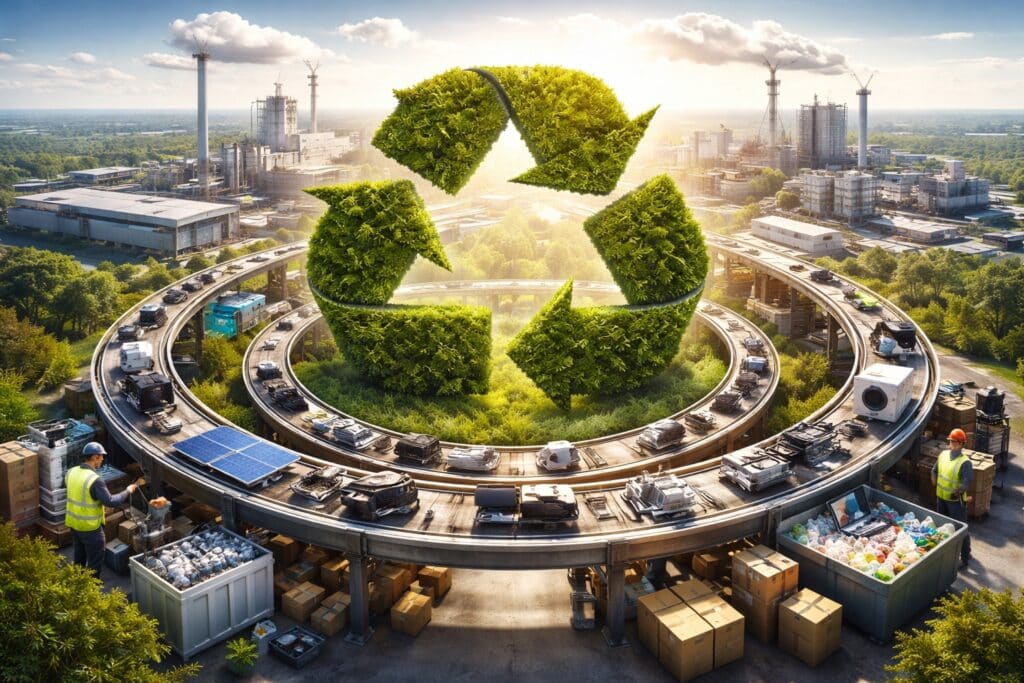
At the heart of the circular economy lie two ideas: slowing loops and closing loops.
1. Slowing Resource Loops
Slowing down loops means extending the lifespan of products. The aim is to delay disposal by designing for maintenance, repair, upgrading, refurbishment, and remanufacturing. The goal is to maximise the product’s usage time before it’s thrown away. This is where durability matters. So do repair services, spare parts, renovation systems, and business models that reward longevity rather than rapid replacement. The longer a product stays useful, the less pressure there is to extract fresh resources and make new goods from scratch.
2. Closing Resource Loops
Closing loops begins when the product’s usefulness has expired. At that point, the focus shifts from the product to the materials inside it. Those materials are recovered and fed back into production through recycling or similar processes. This logic sits close to the Cradle to Cradle approach, which treats resources as part of ongoing cycles rather than as rubbish destined for a landfill. Some of them circulate in technical cycles through industry, while others return safely to biological cycles through composting or biodegradation.
| Feature | Slowing Loops | Closing Loops |
|---|---|---|
| Primary Objective | Extend product life and utilization | Recapture material value after use |
| Impact on Flow | Slows down the speed of material flow | Ensures a circular flow; speed is unchanged |
| Key Activity | Repair, maintenance, remanufacture | Recycling and resource recovery |
| Focus Unit | The Product or Part | The Material or Resource |
Which Business Models Are Most Effective for Scaling Circularity?
Not every business model is built for circularity. Those that work best are the ones that earn value from continued use, recovery, and recirculation, rather than relying only on the quick hit of a one-off sale. Broadly speaking, they fall into two groups: models that slow resource loops and models that close them.
1. Business Models That Slow Resource Loops
These models keep products in use for longer and reduce the need for virgin materials.
Access and Performance Models (Product-as-a-Service): Instead of a direct sale, businesses offer customers the ability to benefit from a product’s functions and capabilities for a fee. As an alternative to selling a jet engine, for instance, a manufacturer may sell or lease “power by the hour”. That changes the incentives completely. If the provider keeps ownership, it has all the motivation to create a robust and easy-to-maintain item. Hilti’s Fleet Management, Philips’ medical-equipment services, and Mister Spex’s eyewear subscriptions all fit this model.
Extending Product Worth: This approach captures value from products by bringing them back through repair, refurbishment, or remanufacturing. Rather than seeing worn or returned goods as dead weight, companies treat them as assets with more life left in them. Patagonia’s Worn Wear, Renault’s remanufacturing operations, and Schneider Electric’s EcoFit show how businesses can generate revenue from items that a linear model would write off.
Sufficiency Models: These methods try to reduce unnecessary consumption in the first place. They rely on durable design, repairability, and a brand message that does not encourage endless replacement. Vitsœ is a notable example here, combining long-lasting products with messaging that pushes back against throwaway habits.
2. Business Models That Close Resource Loops
These focus on recovering value from waste materials or by-products that would otherwise be lost.
Extending Resource Value: This means turning scrap back into useful industrial inputs. Hilti recycles old tool cases into new ones; Renault recovers metals and polymers from end-of-life vehicles; Dell Technologies reuses plastics from discarded electronics. It’s not glamorous, but then neither is losing valuable material because a business fails to build a proper recovery system.
Industrial Symbiosis: This approach repurposes waste or by-products from one process as raw materials for another. Logistically, geography often helps. AB Sugar offers a good example, using heat and CO₂ from sugar refining to support tomato cultivation in nearby greenhouses.
3. A Critical Enabler: Reverse Logistics
None of these models work at scale without reverse logistics. Products and supplies do not magically return into the system on the wings of sustainability ambition. Somebody has to collect them, move them, inspect them, sort them, and get them back to the right place in the right condition.
That involves service-parts planning in the automotive and machinery sectors, careful handling for high-value equipment such as medical devices, or large take-back systems under Extended Producer Responsibility (EPR) schemes for tyres and electronics. Reverse logistics may lack the glamour of a glossy sustainability campaign, but without it, circularity remains mostly a PowerPoint concept.
How Do Companies Successfully Implement Access and Performance Models?
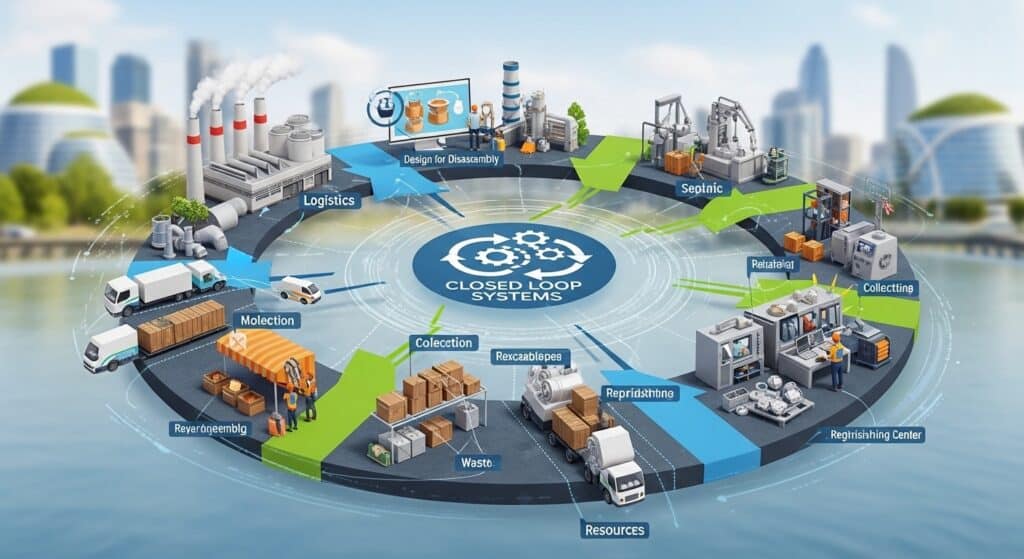
Product-as-a-Service is often presented as a smart idea: stop selling products and start selling access, performance, or outcomes. In reality, it demands a serious shift in how a company thinks, designs, operates, and earns revenue.
1. Strategic Value Alignment
This model works only when access makes more sense to the customer than ownership, as ownership might feel like a burden instead of a benefit.
That is often the case when products are expensive upfront, used only occasionally, subject to rapid technological change, or dependent on specialist maintenance.
2. Incentives for Durability
When the provider retains ownership of the asset, durability becomes a commercial advantage. The company earns more when components last longer, need fewer repairs, and perform reliably over time. That changes the logic of the design. Instead of building for replacement, businesses are pushed to build for longevity, repairability, and lower lifecycle costs. In other words, making units keep on working stops being a noble gesture and starts being good business.
3. Comprehensive Service Bundling
Successful access models go beyond simple rentals. They wrap services around the product to make continued use easy and worthwhile. Those services often include maintenance, repair, upgrades, swaps, insurance, performance monitoring, and data-led support. For the customer, the appeal is convenience. For the company, it means recurring revenue and a closer relationship with the item throughout its lifespan.
4. Technology and Operational Systems
Managing products through multiple cycles of use is complex, so automation becomes essential. IoT systems can track performance and maintenance needs in real time. Subscription-management platforms (like Circuly) handle billing, asset tracking, and contracts. Reverse logistics, meanwhile, allows businesses to collect, refurbish, and redeploy hardware once a contract ends. Without those solutions, Product-as-a-Service quickly stops looking innovative and starts looking chaotic.
5. Clear Value Capture
In these models, revenue usually comes from recurring payments based on time, usage, or performance. That gives businesses more predictable cash flow than one-off sales and provides deeper insight into customer behaviour. When applied to the right sectors, it can offer commercial resilience alongside environmental gains.

Big Tech Accused of AI ‘Greenwashing’

The Truth About Skills & Labour Shortages: Real Crisis or Corporate Fiction?
From Generative AI to Agentic AI: Businesses Advancing the Automation Frontier
Bossware, Bias, and Burnout: The Dark Side of AI in HR

BYD’s Five-Minute EV Charging Now Has a Faster Rival: CATL’s Shenxing 3 Battery

BYD’s Five-Minute Charging Breakthrough: Blade Battery 2.0
Patagonia: Combining Slowing and Closing Loops

Patagonia is often held up as an example of a circular economy because it doesn’t rely on a single tactic. It combines product longevity with material recovery, treating slowing and closing loops as part of the same system rather than as separate sustainability badges.
1. Slowing Loops Through Longer Product Life
Patagonia starts with durability. Its products are designed to last, and the company backs that up with repair services, resale channels, and messaging that openly questions overconsumption. The famous “Don’t Buy This Jacket” campaign was not just clever advertising but a challenge to the logic of disposable retail: buy less, use more, and keep things going. Its Worn Wear programme strengthens that approach by keeping used garments in circulation through refurbishment and trade-in. Repair guides, collaborations with iFixit, and mobile after-sale care all support the same goal: to ensure the product works for as long as possible.
2. Closing Loops Through Recovery and Recycling
When an item can no longer be repaired or reused, Patagonia tries to recover the material value by returning it to production. That is where closing the loop begins.
Hilti’s Durable Recycled Plastic Cases

Hilti provides a useful industrial example because it shows that using recycled materials does not necessarily result in weaker products. In sectors where durability and safety are non-negotiable, that matters.
1. Rigorous Testing
Hilti subjects its new and recycled plastic cases to demanding performance standards – like the UN regulation for the transport of dangerous goods – to ensure they are suitable for industrial use. To illustrate, the cases are dropped from 1.2 metres in a freezing environment at around -80 degrees Celsius. Upon impact, they must not break or fracture.
2. Material Control and Assessment
The company also controls the quality of its feedstock by assessing returned cases before recovery. Some can be reused directly, while others are channelled into recycling. Sorting matters because contamination weakens the final product or affects consistency. This is one of the less glamorous truths of circular manufacturing: disciplined material management.
3. Integrated Manufacturing
By managing the shredding, cleaning, and sorting processes closely, Hilti is able to reintroduce recovered material into production while maintaining product standards. That allows the company to support a closed-loop model without asking customers to accept lower quality in exchange for greener credentials.
How Can Companies Incentivise Customers to Return Used Products?
Circular systems are only as strong as their return flows. If customers keep old products in lofts, drawers, garages or storerooms, the loop breaks. Companies therefore need to make returns financially attractive, convenient, and worth the effort.
1. Direct Financial Incentives
Money is an effective motivator. Trade-in schemes, buy-back programmes, deposit systems, and store credit all give customers a clear reason to return products rather than abandon them. Programmes such as Patagonia’s trade-in credits or Gazelle’s electronics buy-back scheme show how simple financial rewards can improve recovery rates.
2. Built-In Returns Through Business Models
In leasing and Product-as-a-Service, returns are embedded into the structure of the relationship. The provider retains ownership, so the asset is expected to come back when the contract ends. Hilti’s Fleet Management operates this way, helping the company recover tools, batteries, and cases without relying solely on customer goodwill.
3. Convenience and Seamless Logistics
Convenience matters as much as reward. If returning a product is awkward, confusing, or time-consuming, many people will not bother. The best systems make it easy through collections, clear drop-off points, scheduled pick-ups, or exchange arrangements in which an old part is taken away when a new or refurbished one arrives. The simpler the process, the higher the chance that the item comes back.
4. Guarantees, Trust, and Engagement
A few businesses also strengthen returns through long-term faith. Operational reliability commitments, transparent information, and clear sustainability messaging can all reinforce the idea that the customer is part of an ongoing system rather than the endpoint of a sale. When consumers see a company as a partner in maintenance and recovery, they are more likely to stay within that loop.
The circular economy is no longer a decorative phrase in sustainability reports or a fashionable badge for brand campaigns. It is becoming a practical test of how businesses make money, manage materials, and think about value after the point of sale.
The companies making real progress are not relying on vague promises. They are redesigning products for durability, investing in reverse logistics, and building revenue models around repair, reuse, remanufacturing, and service. Patagonia and Hilti prove that circularity works best when it is embedded in operations rather than bolted on as a marketing fancy touch.
For businesses, the next move is evident, even if the work is not. Audit where value is leaking; identify which products could be repaired, returned, leased, or remanufactured; and build the systems and partnerships that make those loops possible.
Circularity won’t be delivered by good intentions alone. It will be built by companies willing to rethink how value is created, retained, and recovered.