For over a hundred years, a single chemical has served as the silent workhorse of American industry and even laundered your clothing. Called the “miracle” solvent, it cleaned clothes at your local dry cleaners, degreased the heavy metal parts in countless factories, and decaffeinated your coffee. But under the radar, this chemical permeated groundwater and soil, leaving behind a toxic legacy that we are only now beginning to reckon with.
The protagonist of today’s story is the abominable trichloroethylene (TCE). We have long relegated TCE to the realm of “blue-collar” industrial hazards, assuming that only those with direct exposure to it could be affected. A fatal error that ignores the fluid dynamics of vapour intrusion and the porous nature of the buildings where people, unaware of the danger, live and work.
Recent research identifies TCE as a primary driver of the world’s fastest-growing brain condition: Parkinson’s disease. This is an urgent public health crisis, no longer an industrial footnote.
The 500% Factor: A Staggering Increase in Risk
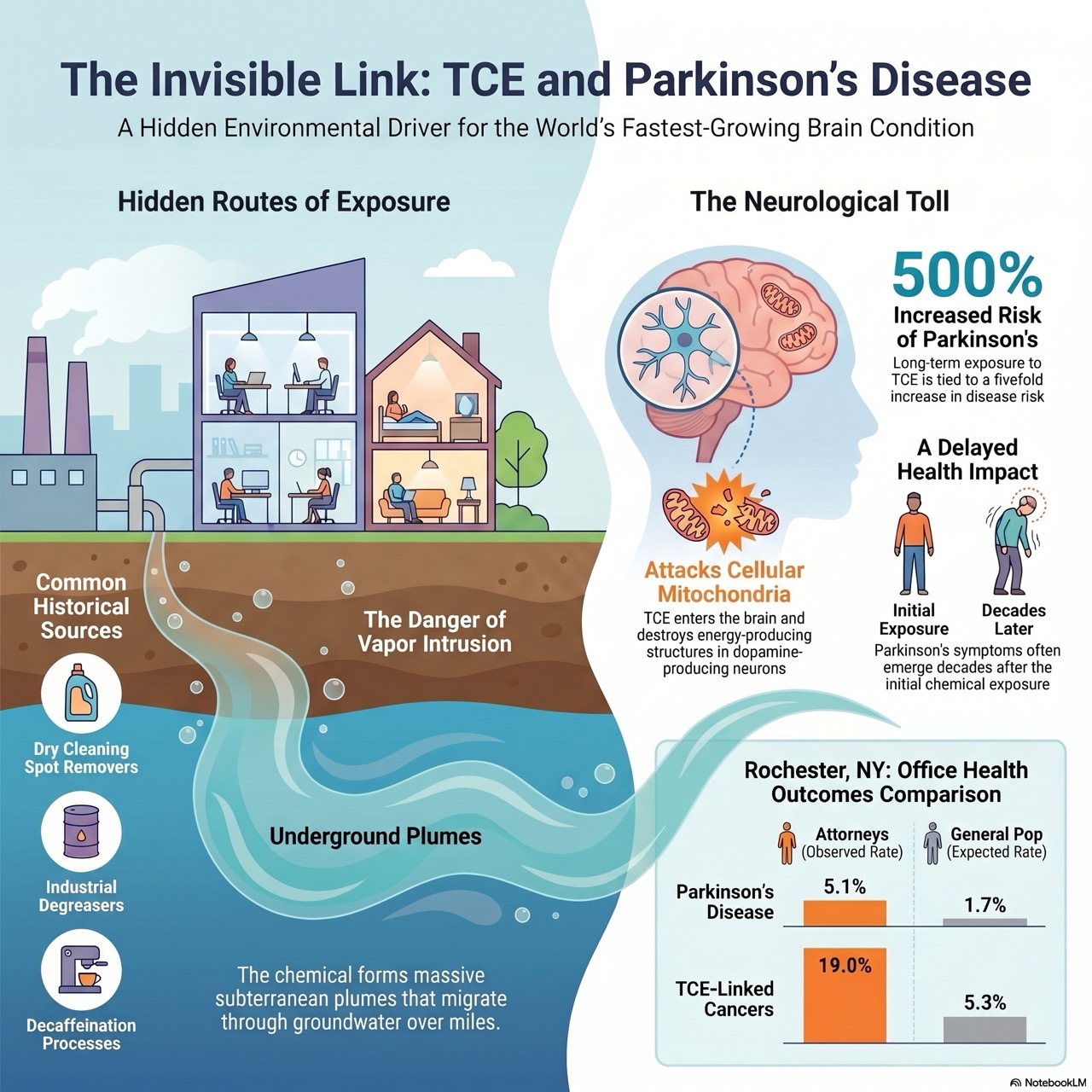
According to the current study, exposure to this chemical is tied to an alarming fivefold increase in the risk of developing Parkinson’s disease. This figure represents a major public health concern rather than a minor statistical anomaly. It suggests that TCE isn’t merely a contributor to neurodegeneration but a primary environmental catalyst.
To understand the ubiquity of this hazard, you only need to look back at the 1970s, when US production peaked at over 600 million pounds per year (roughly two pounds for every man, woman, and child in the country). For those exposed through contaminated water sources, such as the high-profile cases at Camp Lejeune, the risk of developing Parkinson’s is significantly higher than for those unexposed.
Vapour Intrusion: The Invisible Plume in Your Living Room
One of the most insidious aspects of TCE is its volatility. You don’t need to handle the chemical to be threatened; you only have to breathe the air above it. When TCE seeps into the earth, it forms vast underground plumes that migrate with the groundwater. On Long Island, a single plume of contamination now measures four miles long and two miles wide, a subterranean ghost haunting a large area.
When these plumes sit beneath residential or commercial areas, the chemical volatilises, rising through the soil as a gas. Through a process known as ‘vapour intrusion’, TCE enters homes, schools, and offices via foundation cracks and crawl spaces.
The irony is profound. In the United States, authorities have successfully standardised testing for radon – a naturally occurring radioactive noble gas – yet they have remained blind to the risks of this man-made neurotoxin.
The Professional Risk: A Modern Office ‘Cluster’
As mentioned before, the danger of TCE is dismissed as a relic of the factory floor, but a study of attorneys in Rochester, New York, is a jarring reminder for urban workers. These professionals worked in an 18-storey office building located 300 feet from a former dry-cleaning site. Between 1950 and 1994, that site released both TCE and its sister chemical, perchloroethylene (PCE), into the ground. Data from this group reveals a disturbing pattern:
- Parkinson’s Rate: 5.1% of the attorneys had the disease compared to a baseline rate of 1.7% adjusted for age and sex.
- Cancer Rate: 19% suffered from TCE-linked cancers, such as kidney and prostate cancers, relative to 5.3% within a reference group.
While researchers pointed out that the difference in Parkinson’s rates as opposed to a separate reference cohort was not significant, the figures still exceed general expectations. Although these attorneys were not industrial workers, they were exposed to the TCE in the groundwater flowing towards their building’s underground garage.
How Does a Common Degreaser Trigger a Complex Neurological Disorder?

TCE behaves as a biological saboteur by targeting the mitochondria, the “power plants” of your cells. Once TCE crosses the blood-brain barrier, it damages these energy-production structures, destroying dopamine-producing neurons. The loss of these specific cells is the defining feature of Parkinson’s disease. Furthermore, TCE appears to activate the LRRK2 kinase pathway, a biological “tripwire” also associated with genetic forms of the disease.
In this sense, TCE pulls the trigger of a “genetically loaded gun”, providing an environmental backdoor to a disease once thought to be primarily inherited or age-related.

How a Health Administration Degree Opens Doors to Leadership in Healthcare

Do Patients Who Suffer Heart Attack Have More Micro and Nanoplastic in Their Blood? New Study Assessed

Can Ozempic Prevent Cancer? A Doctor Explains Why the Headlines Are Easy to Misread

The Government Knows The Real Climate Threat. Why Is It Hiding It?

Big Tech Accused of AI ‘Greenwashing’

Digital Surveillance is Breaking Activist Mental Health
The Decades-Long Ticking Clock
It’s extremely difficult to hold anyone accountable for this contamination, as it lies in the long-term environmental legacy. Parkinson’s disease often manifests decades after the initial exposure. Given that TCE production peaked in the 1970s, we are currently living through the neurological fallout of a 20th-century industrial boom.
The “crime” happened over fifty years ago, but the clinical consequence is a surge in brain disorders today. As of April 2026, the urgency has never been higher, because we continue to identify new clusters of cases linked to decades-old spills.
The Regulatory Standoff
While the science is clear, the cleanup is mired in administrative and industrial friction. In December 2024, the EPA finalised a rule to prohibit all uses of TCE. However, as is often the case, this progress has been slowed by aggressive court challenges and red tape. Besides, several ‘critical infrastructure’ and ‘national security’ exemptions have been granted, extending the compliance timelines for certain sectors and leaving the door open for continued use.
The tragedy of this delay is that the technology to protect the public is already available. Contaminated sites can be cleaned up, and indoor risks eliminated using vapour mitigation systems – the same low-tech, inexpensive vent pipes used to address radon.
Past industrial choices are actively affecting our current neurological health. We prioritised efficiency at the cost of our groundwater and air, and now, we are paying the ‘Parkinson’s tax’ on that 20th-century progress.