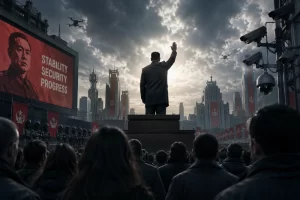
Is history cyclical? Perhaps not, but it rhymes with unsettling precision. Every empire that has ever ruled the world has eventually collapsed, from the Achaemenid Persians to the British viceroys. And the recipe for collapse has remained remarkably consistent across millennia: fiscal overreach, military adventurism, political corruption, social division, and the corrosive loss of institutional trust.
Though it rarely calls itself an empire, the United States has been following this same formula, and the parallels are too precise to ignore.
As historian Mike Duncan, host of The History of Rome, put it bluntly in 2025: “Everyone has an expiration date. Every entity has a lifespan, and inevitably, there comes a phase of decline. The United States remains immensely powerful; we are not on the brink of vanishing from the global stage. Yet, does it seem like we are heading towards some form of terminal failure? Absolutely, it certainly feels that way.”
In the course of this report, we’ll examine the imperial decline in Rome, Persia, the Spanish Habsburgs, the Ottomans, and the British Empire and hold each lesson up against the mirror of contemporary America.
The Anatomy of Imperial Rise: The Common Architecture of Power
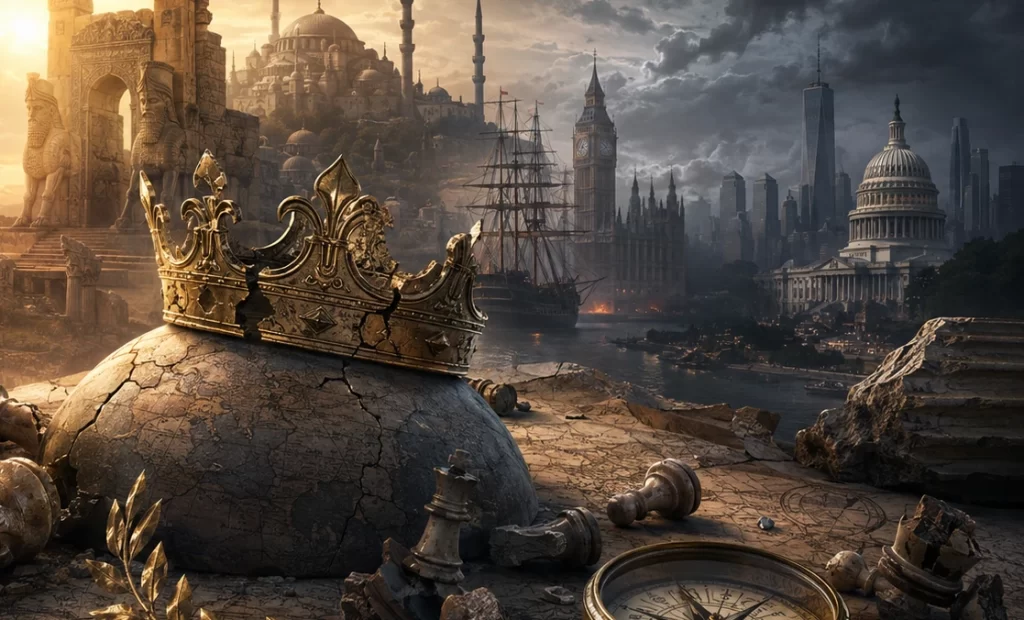
Every great empire has climbed to dominance using a well-known scaffold: military innovation, economic productivity, institutional strength, and cultural confidence, together with the ability to project power beyond its borders.
For instance, Rome’s disciplined legions and unifying legal code transformed a city-state into a Mediterranean colossus. From Asia, the Mongols mastered military mobility across the largest contiguous land empire in history. The British, on their part, leveraged naval supremacy with huge industrial production plus a global trading network to control almost a quarter of the world’s surface.
After WWII, in 1945, the United States wrote its own version of this script with unmatched military strength while placing the dollar as the world’s reserve currency. And let’s not forget technological superiority, cultural soft power through Hollywood and Silicon Valley, in addition to leadership of international institutions from the UN to the WTO. By the time the Soviet Union dissolved, the US stood alone as what commentators called the planet’s sole “hyperpower”.
Seeds Planted in Greatness
An empire’s success also lays the groundwork for its eventual failure. Edward Gibbon, whose monumental History of the Decline and Fall of the Roman Empire (1776) remains the canonical text on imperial mortality, wrote with characteristic directness:
“The decline of Rome was the natural and inevitable effect of immoderate greatness. Prosperity ripened the principle of decay. The causes of destruction multiplied with the extent of conquest; and, as soon as time or accident had removed the artificial supports, the stupendous fabric yielded to the pressure of its own weight.”
Ray Dalio, the hedge fund billionaire who spent years mapping the rise and fall of the Dutch and British empires, found that this pattern is a measurable economic and political cycle. In his framework, empires often begin after a major conflict establishes a new dominant power, followed by a period of peace and prosperity, which fuels borrowing and financial bubbles, growing wealth inequality, internal battles between rich and poor, and external challenges from rising rivals.
Dalio has maintained that the United States is in Stage 6 of this cycle, a phase he calls “global disorder”, where “there are no rules, might is right, and there is a clash of great powers.”
The Fall: Six Recurring Causes
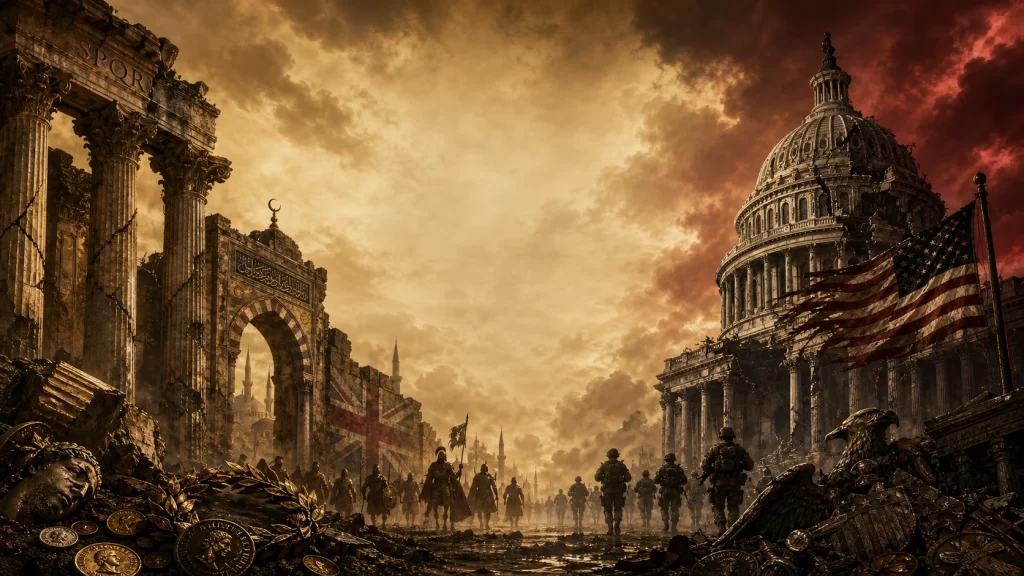
Number 1: Financial Overextension and Currency Debasement
Through imperial collapses, the single most consistent thread running is the inability to pay the bills. Empires cost tonnes of money – for armies, roads, bureaucracies, and the endless management of distant provinces. Thus, when revenue stops covering expenditures, rulers have historically turned to the same dangerous remedy: debasing the currency.
To illustrate this point, Rome reduced the silver content of its denarius from 90% to less than 5% over three centuries, triggering hyperinflation. The Spanish Habsburgs, overflowing with America’s silver and the most powerful monarchy in Europe between 1557 and 1666, declared bankruptcy nine times. Philip II’s Spain was overwhelmed by the burden of endless wars against France, the Ottomans, and England. So, as soon as the silver from the New World poured in, it flowed straight out to pay foreign creditors. On the other side of La Manche, centuries later, Britain achieved victory over Germany in the Second World War but lost its empire in the process. Britain emerged from 1945 devastated, carrying catastrophic debt and unable to maintain its global commitments.
Shifting focus to the United States, as of May 2026, the total US gross national debt stands at $38.91 trillion – growing at around $7.39 billion per day. As a percentage of GDP, government borrowing reached 122.6% in Q4 2025, with the net interest paid on this debt almost tripling over the last five years. As reported by the Congressional Budget Office, interest payments alone will consume 14.52% of all federal outlays by FY2028. This is a similar trap that swallowed Rome and exhausted the Habsburgs.
Number 2: Military Overextension and Endless Wars
“A great empire, like a great cake, is most easily diminished at the edges.” Benjamin Franklin.
Every global power chooses expansion over consolidation. Take the Ottoman Empire. It stretched its forces across three continents – North Africa, the Balkans, the Middle East – until its army could no longer recruit or maintain morale. Military defeats against Greece (1821-1832), Serbia (1876-1878), and the catastrophic losses of the First World War left the empire unable to hold its periphery. As Britannica notes, the decline began even earlier, when Sultan Suleiman the Magnificent “withdrew more and more from public affairs to devote himself to the pleasures of his harem”, leaving authority to corrupt grand viziers.
Rome’s military overextension became fatal when the empire could no longer afford to defend its borders with citizen-soldiers and resorted to mercenaries with no loyalty to Roman ideals. Between 235 and 284 AD, twenty-six individuals claimed the title of emperor, and this political instability at the top translated into military vulnerability at the frontiers.
The United States has spent the post-9/11 era waging wars. For example, the conflicts in Iraq, Afghanistan, and more recently with Iran could reach $4 to $6 trillion, as per Harvard Kennedy School. On fatalities, Al Jazeera puts the direct death toll of US-led wars since 2001 close to 940,000 people, while indirect deaths from loss of healthcare and food security bring the total death figures to between 4.5 and 4.7 million.
And, like Rome, the US has its own mercenaries; call them “private armies” or “defence contractors”, with the most notable being Academi (formerly Blackwater) and Constellis.
Now, despite possessing the world’s most powerful military, the US didn’t achieve its strategic objectives in many of the wars it has fought since the end of the Second World War. America could not prevail militarily in Korea (1950-1953, with 37,000 killed and 92,000 wounded); it lost Vietnam (1965-1973, with 58,220 fatal casualties and 303,644 wounded); it shamefully left Afghanistan after two decades (2001-2021, with 2,459 killed, over 20,000 wounded, around $2.3 trillion spent) with the Taliban once again in power. And today, the ongoing war with Iran, which has depleted the US’s missile stockpile to a level that will take several years to restore. Iran’s still standing regardless of months of bombing, destruction of civilian infrastructure, and economic blockage.
Number 3: Corruption and the Decay of Institutions
“Civilisations die from suicide, not by murder.” Arnold Toynbee.
Toynbee’s point was that the decisive blows to great powers always come from within, not from without. And corruption is the mechanism by which that internal suicide is committed.
Under the later Achaemenids, bureaucratic embezzlement had eaten so deeply into the Persian Empire that it had become vulnerable to Alexander the Great long before he crossed the Hellespont. Rome experienced the same phenomenon, but at a faster rate. Roman historian Sallust described how the destruction of Carthage – Rome’s biggest external rival – removed the one pressure which had kept Roman elites honest.
“The lust for money first, then for power, grew upon them; these were, I may say, the root of all evil. For avarice destroyed honour, integrity, and all other noble qualities.”
Cicero, Rome’s famous orator, documented the corruption of magistrates like Gaius Verres and warned the Senate that unless the law applies equally to all, the reputation of Roman dominion would be shattered. Tacitus’s observation, “the closer the collapse of the empire, the crazier its laws”, is a recognisable symptom of a republic in its final phase.
The Ottoman Empire’s kleptocracy was institutional and systemic. As political authority shifted from competent sultans to their favourites and viziers, “corruption seeped into every level of administration”. Reform efforts were always undermined by entrenched elites who preferred personal profit to institutional renewal.
In America, Thomas Jefferson foresaw this dynamic with haunting clarity in 1785.
“The time is not distant when corruption in this, as in the country from which we derive our origin, will have seized the heads of government, and be spread by them through the body of the people; when they will purchase the voices of the people and make them pay the price.”
George Washington, in his 1796 Farewell Address, named the vehicle of this corruption with equal precision – political parties – which he feared would become “potent engines, by which cunning ambitious, and unprincipled men will be enabled to subvert the power of the people and to usurp for themselves the reins of government.”
Those warnings read today as contemporary diagnostics. As of April 2026, Congressional approval in the United Statesstands at just 10%. A Gallup survey records that even Republican support of the Republican-led Congress has dropped to 18%; independents register at 8%; Democrats at a catastrophic 3%.
American democracy operates under a patchwork of ethics laws, including the STOCK Act, the Pardon Clause, campaign finance rules, and federal contracting oversight, that were designed to prevent self-enrichment and foreign influence in public office. But in practice…
Lawmakers often buy and sell shares in the very sectors they regulate with minimal consequence, as in the cases of Markwayne Mullin, Lisa McClain, Dan Crenshaw, and Nancy Pelosi. Also, congressional representatives, their spouses, or children trade defence stocks ahead of military conflict, including Marjorie Taylor Greene, Josh Gottheimer, Bruce Westerman, Gil Cisneros, Jefferson Shreve, Ashley Moody, Bob Bresnahan, and Michael McCaul.
Trump’s family has built a multibillion-dollar personal fortune from a cryptocurrency venture. World Liberty Financial (WLF), co-founded by Donald Trump, Donald Trump Jr., Eric Trump, Barron Trump, and Steve Witkoff, has reportedly profited more than $1 billion. Related entanglements have surfaced, like the one of crypto billionaire Justin Sun, who invested $30 million in WLF in late November 2024 shortly after Trump was re-elected. Following that, an SEC investigation was dropped. President Trump also pardoned Changpeng Zhao, the Binance founder convicted of anti-money-laundering, after Binance helped generate substantial revenue for WLF.
Pardons have come to favour campaign contributors over the interests of justice. Documented cases include:
- Julio Herrera Velutini (charged with bribery)
- Trevor Milton (convicted of defrauding investors)
- Paul Walczak (convicted of stealing $10 million from employee paycheques)
- Joseph Schwartz (sentenced to three years for $39 million payroll tax scheme)
- Adam Kidan (pleaded guilty to conspiracy and fraud)
A New York Times review discovered that of 346 major post-election donors tracked, 197 had gained financially or were tied to sectors that benefited from actions including pardons and favourable regulatory changes.
Contractors defrauded the government of billions in a war zone. The Special Inspector General for Afghanistan Reconstruction (SIGAR), established by Congress to oversee the $145 billion the US spent rebuilding Afghanistan, has documented a level of fraud unprecedented. A December 2025 SIGAR retrospective concluded that Washington’s effort “became a massive cycle of corruption, waste, and abuse of billions of dollars”, documenting 1,327 individual cases of embezzlement and fraud totalling $29.2 billion in losses.
Let’s not forget the Epstein files. No major US figure named in the released documents has been prosecuted or jailed in connection with the sex-trafficking ring.
And finally, a single foreign-policy lobby now finances the campaigns of a majority of Congress. The American-Israel Public Affairs Committee (AIPAC) has become the most dominant outside spender in congressional elections. For instance, in the 2023-2024 election cycle, AIPAC spent $126.9 million, including $55.2 million in direct candidate contributions, according to FEC filings compiled by Sludge. Every AIPAC-endorsed candidate who appeared on a general election ballot in 2024 won. A separate tally found 349 members of the 119th Congress, or 65% of the full body, received AIPAC-affiliated money in that cycle alone. AIPAC’s spending is concentrated on removing progressive politicians critical of Israeli government policy. The following video provides further context:
Number 4: Political Polarisation and the Loss of Civic Unity
Every declining empire has been marked by a fracturing of the social consensus that originally bound it together. Rome’s late Republic was consumed by the conflict between Optimates (the senatorial elite) and Populares (reformers allied with the common people). As the historian Sallust recorded:
“The pattern of routine partisanship and factionalism and, as a result, of all other vicious practices had arisen in Rome… every man acted on his own behalf, stealing, robbing, plundering. In this way, all political life was torn apart between two parties, and the Republic, which had been our common ground, was mutilated.”
Ray Dalio has described the US sitting in Stage 5 of his internal disorder cycle, a state that historically ends in civil war or revolutionary transformation. His analysis notes that the changes occurring in America over the past decade – rising inequality, massive deficits, and a shifting global outlook – are all interconnected and part of a dynamic that has occurred many times before for the same reasons.
The United States enters its 250th anniversary year with clear evidence that its civic fabric is tearing across nearly every dimension. America’s polarisation has turned into a deep-seated enmity towards the opposing political tribe. Gallup found that the share of Americans labelling themselves as moderate fell to a record low of 34% in 2025, with 77% of Republicans self-identifying as conservative and 55% of Democrats as liberal.
But the starkest evidence of eroding civic unity is the rise in politically motivated violence. As published by CSIS, between 2016 and 2025 there were 25 documented attacks and plots targeting elected officials, candidates, judges, and government employees driven by partisan extremism, more than triple across the preceding twenty-five years combined. The list of high-profile incidents in 2025-2026 alone illustrates how this violence spans the political spectrum:
July 2024 / September 2024: Two assassination attempts against then-candidate Donald Trump.
April 2025: An arsonist firebombed the house of Pennsylvania Governor Josh Shapiro.
May 2025: Two Israeli Embassy staff members were gunned down in Washington, D.C.
June 2025: Minnesota legislator Melissa Hortman and her husband were assassinated. State Senator John Hoffman and his wife were wounded in a related attack.
September 2025: Activist Charlie Kirk was shot and killed while speaking at Utah Valley University.
November 2025: Assaults on ICE officers rose more than 1,150% compared with the same period the previous year.
April 2026: An armed individual rushed a security checkpoint outside the White House Correspondents’ Dinner.
May 2026: A shooting at a mosque in San Diego killed three people.
One of the clearest signs that some Americans no longer see continued unity as viable is the growth of organised secessionist rhetoric, such as when Marjorie Taylor Greene called for a “national divorce” separating red and blue states in 2023. A 2023 YouGov poll found 23% of Americans supported the concept, and Greene renewed the call in September 2025 in the aftermath of Charlie Kirk’s assassination. Most dramatically, secessionist support rose from 13% to 23% in Minnesota, from 9% to 22% in Connecticut, and from 16% to 29% in California.
At the same time, a New York Times/Siena poll found that 64% of Americans believe the country is too divided to address its challenges, up from 42% in 2020, while the share who consider the nation can still solve its problems fell to 33%.
Number 5: Bread, Circuses, and the Distraction of the Masses
“The masses have long since thrown off their cares. The people who once bestowed military commands, consulships, legions, and everything else no longer involved themselves and now yearn with all their heart for only two things: bread and circuses.”
Around AD 100, the Roman poet Juvenal coined the phrase panem et circenses (bread and circuses) to describe how the ruling class kept the crowds docile. Academic research has explicitly drawn this parallel to modern America, where mass distractions through entertainment, media, and governmental discourse serve to divert attention from pressing issues such as political corruption.
Of course, the tools have evolved – social media algorithms, 24-hour news cycles – but the mechanism is identical. Gibbon noted the same dynamic in Rome’s final centuries, writing that the emperors’ courtiers introduced “a slow and secret poison into the vitals of the empire” by destroying the public courage “nourished by the love of independence, the sense of national honour, the presence of danger, and the habit of command”.
No one admires generals, founding fathers, or smart personalities anymore. Millions worship those on the screens, like influencers and their false lifestyles, the Kardashians or MrBeast, no matter how empty-headed their shows are. People just want to imitate them.
Number 6: The Erosion of Soft Power and Global Legitimacy
Empires do not start with a military or economic collapse. They first lose the narrative, the story that justifies their dominance to themselves and to others. This is what Joseph Nye calls “soft power”, and its loss historically precedes hard power decrease by a generation.
Two world wars fatally wounded the British Empire’s legitimacy. The moral contradiction of fighting for freedom while maintaining colonial subjects and the rise of nationalist movements from India to Kenya could no longer be contained. Mahatma Gandhi did not defeat the British army. He defeated Britain’s self-belief.
The United States recorded the steepest overall decline of any nation in the Brand Finance Global Soft Power Index 2026, falling across every metric except global familiarity. A 2025 worldwide survey found the US net image had fallen to -5% from +22% a year earlier, while China rose to +14%. Meanwhile, Donald Trump received negative ratings in 82 of the 100 countries surveyed. China’s reputation has overtaken the US in international standing for the first time.
Empire Comparison – The Pattern in Parallel

The table below summarises the six recurring causes of imperial decline against each empire’s specific experience and the current American trajectory.
| Cause of Decline | Roman Empire | Ottoman Empire | Spanish Habsburgs | British Empire | United States (2026) |
|---|---|---|---|---|---|
| Corruption | Emperors like Nero and Commodus prioritised personal gain; Senate lost influence | Corruption at every level of administration; weak sultans; venal viziers | Court favourites (Duke of Lerma); purchase of positions; rampant ennoblement | Colonial system’s moral bankruptcy; loss of legitimacy to nationalist movements | Congressional approval 10%; top 1% hold 32% wealth; political patronage resurgent |
| Political Division |
Republic destroyed by optimates vs. populares; civil wars; assassination | Dynastic fratricide; provincial separatism; religious conflicts | Court favouritism; regional rebellions; crisis of 1640 | Labour-Tory splits over empire; war fatigue fracturing political will | Political polarisation at historic levels; Gini coefficient highest in 60 years |
| Fiscal Overextension |
Silver denarius debased from 90% to <5%; unsustainable military spending | Financial crises from military campaigns; loss of trade routes | 5 bankruptcies 1557–1666; silver from Americas squandered on wars | WWI and WWII debt; economically devastated by 1945 | $38.91T national debt; growing $7.39B/day; debt-to-GDP at 122.6% |
| Military Overextension |
800+ miles of frontier; reliance on mercenaries; 26 emperors in 49 years | Overextended from N. Africa to Eastern Europe; military defeats accelerated separatism | Continuous wars against France, Ottomans, Netherlands, England | Two world wars; colonial overstretch; collapse after 1945 | $997B annual military spend; failed wars in Vietnam, Iraq, Afghanistan; 800+ bases globally |
| Bread and Circuses |
Grain dole + Colosseum spectacles used to pacify urban masses | Religious entertainment and patronage to maintain loyalty | Church, Inquisition, and festivals as social control mechanisms | Cricket, football, music hall as safety valves during colonial stress | Social media, reality TV, celebrity culture, partisan news as digital distraction |
| Soft Power Erosion |
Loss of Roman civic identity; moral authority questioned by the subjects | “Sick man of Europe” label; inability to project attractive governance | Inquisition and religious rigidity alienated Europe’s intellectual class | Gandhi, Mandela, Ho Chi Minh undermined British moral authority | US soft power fell to -5% global net image; China’s reputation overtook US for first time |
The Dollar: The Reserve Currency Trap
Amongst the most outstanding similarities between today’s America and earlier empires is the role of the reserve currency. When Rome debased the denarius, it obliterated the trust that underpinned its entire imperial economy. And when the pound sterling lost its global reserve status after WWII, British hegemony evaporated within a generation.
Since 1944, the US dollar has been the world’s reserve currency. In 2000, it accounted for around 70% of central bank reserves worldwide. However, by Q3 2025, data show that share has plummeted to 56.92%.
In 2025, central banks purchased over 863 tonnes of gold, the largest annual increase in 70 years. Russia and China now settle 90–99% of bilateral trade without touching American dollars. The BRICS alliance has deployed parallel financial infrastructure to bypass SWIFT and the dollar-dominated clearing system. Furthermore, the US weaponisation of the dollar to punish and intimidate those that oppose its policies might have accelerated this shift, with some countries looking at the yuan as an alternative for certain operations.
Based on what’s happened before, this trend seems to be the slow migration that precedes the loss of reserve currency status.
The Warnings That Were Ignored
History’s cruellest irony is that the leaders of declining empires almost always had prophets warning them of the trajectory. The Romans had Cicero; the British had Gibbon and Keynes; and the Americans, their own founders.
In 1785, Jefferson warned that the time to guard against corruption and tyranny is before they take hold: “It is better to keep the wolf out of the fold than to trust to drawing his teeth and talons after he shall have entered.”
A few decades later, in his 1838 address to the Young Men’s Lyceum, Abraham Lincoln stated:
“At what point then is the approach of danger to be expected? I answer, if it ever reaches us, it must spring up amongst us. It cannot come from abroad. If destruction be our lot, we must ourselves be its author and finisher.”
Arnold Toynbee, having studied many societies, said that of the twenty-six civilisations that have appeared in history, nineteen of them collapsed when they reached the moral state the US is in now.
“Civilisations, I believe, come to birth and proceed to grow by successfully responding to successive challenges. They break down into pieces if and when a challenge confronts them that they fail to meet.”
Is Decline Inevitable?
The answer is no. It is not inevitable. But it requires something that declining empires have historically found impossible to produce: a governing class willing to accept less in order to preserve more.
When we compare the British Empire with Rome, British institutions retained enough flexibility to adapt, transitioning from direct imperial control to the Commonwealth, decolonising without a full-scale military debacle. It lost its empire, indeed, but it did not lose itself.
Ray Dalio, who places the US in the most dangerous phase of its supremacy, stops short of forecasting inevitable collapse, but his conditions for avoiding the worst include a structural reform of the debt cycle, reduction of political polarisation, investment in education and infrastructure, as well as the wisdom to manage the transition to a multipolar world without resorting to catastrophic conflict.
Every empire has confronted this verdict. The United States is confronting it now.