It starts with optimism: a freshly polished CV, a tailored cover letter, and the quiet belief that this one feels different. You submit the application, refresh your inbox, and wait. Days pass. Then weeks. No rejection, no interview — just silence: thick, indifferent, absolute. Eventually, it dawns on you: the job never existed.
This is the cruel, and sadly, common world of Ghost Jobs.
Through this article, we pull back the curtain to reveal the nature of ghost jobs, why companies post them, and how your data is quietly harvested. Also, which industries are most affected, and what you can do to avoid wasting months chasing phantom roles that were never open to begin with.
Because the real scandal isn’t just that these jobs are fake; it’s how normalised the illusion has become.
What Are Ghost Jobs? Why Do Companies Post Them?
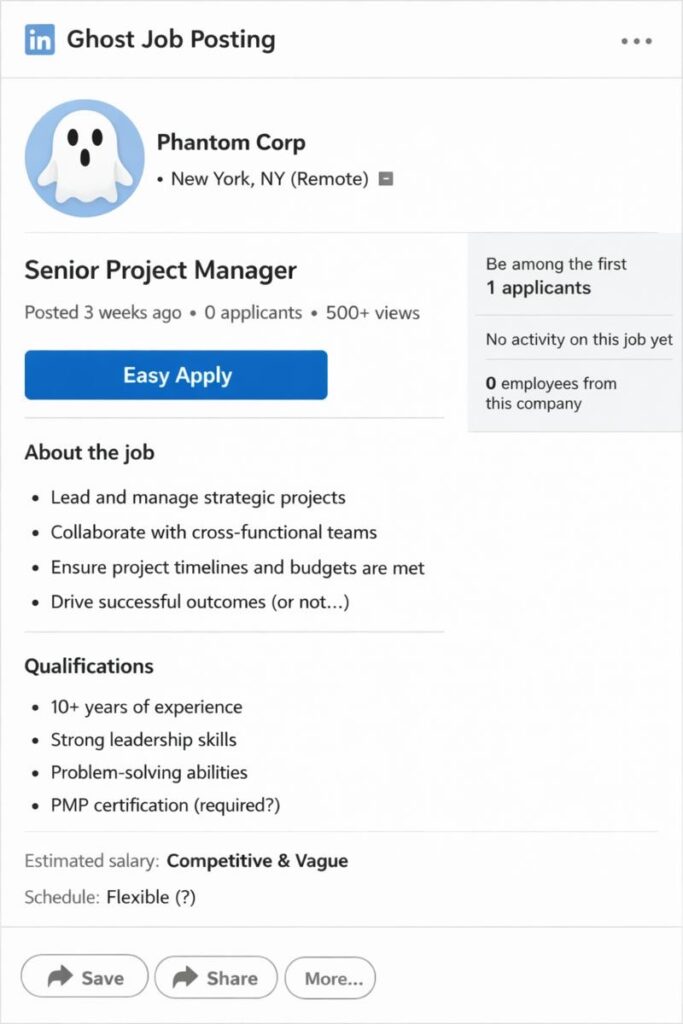
Ghost jobs, phantom postings, or fake jobs are ads for roles that either do not exist or for which the employer has no immediate intention to hire. They aren’t scams in the traditional sense since they are listed by real companies, but the “vacancy” itself is an illusion.
Research indicates that this phenomenon is rampant, with estimates suggesting that between 20% and 40% of all online job ads may be ghost listings. This obviously distorts the job market, draining candidates’ time, energy, and hope.
What drives companies to post these roles? Strategic, operational, and sometimes unethical reasons that include:
Projecting Vitality
Many organisations keep an active careers page to signal financial stability and expansion to investors, stakeholders, and competitors. By appearing to be in a constant state of growth, they aim to boost corporate reputation or investor confidence, even during hiring freezes.
Brand Visibility
Frequent postings place a company’s brand “top-of-mind” for talent and may serve as a low-cost marketing tool to draw traffic to the corporate website.
Building a Reserve
This relates to pipeline maintenance, where companies collect resumes to build a database of pre-vetted applicants. This allows them to onboard candidates rapidly the moment a real vacancy is approved.
Catching “Unicorns”
Businesses post specialised roles without urgency, only to catch “unicorn” talent whose exceptional skills justify a hire regardless of budget constraints.
Employee Manipulation
Managers might use ghost jobs as a pressure tactic, listing current employees’ positions to make them feel replaceable and drive higher productivity through fear.
False Hope for Overworked Staff
Listings are sometimes used to appease overstretched teams by creating the illusion that extra help is being recruited, despite no such budget existing.
Satisfying Policy Requirements
Large organisations, as well as government agencies, often post roles publicly to follow fair-hiring regulations, even if they’ve already chosen an internal candidate for the position.
Salary Benchmarking
Phantom listings gauge current salary expectations and the availability of specific skills in the market without hiring.
Data Extraction
In some cases, ghost jobs serve as a vector for data harvesting, where organisations extract sensitive personal information – such as ethnicity, gender, and disability status – to build comprehensive dossiers on individuals.
Operational Friction
Many “ghosts” result from administrative lag, such as failing to remove a filled posting or experiencing a budget freeze shortly after an ad was published.
Algorithmic Maintenance
Recruitment software and aggregators such as LinkedIn or Indeed frequently refresh or repost jobs, including inactive ones, to maintain platform visibility or manipulate the algorithm.
What Personal Data Do Companies Harvest from Ghost Postings?
Ghost jobs let organisations collect extensive private information from applicants who innocently share their data under the false expectation of employment. Since these postings originate from legitimate organisations, their inherent credibility ensures that job seekers rarely suspect a ruse.
They have access to your:
- Full Employment Work History
- Contact Details (full names, email addresses, phone numbers)
- Personal Attributes
- Ethnicity and Gender
- Sexual Orientation (under the guise of diversity and inclusion)
- Disability or Veteran Status
The Mechanism of “Illusionary Consent”
Data extraction often takes place through “privacy contracts” or click-wrap agreements that applicants hardly ever read. In reality, they serve as “golden tickets” for companies to legally collect, use, and disclose data. Legal scholars argue that because there is no genuine intent to hire, this practice reflects an evolution in deceit that breaches the social contract of the digital economy.
Once collected, this sensitive information is often misused in ways that extend beyond the initial application:
- Third-Party Sales: Harvested data can be sold to others for targeted advertising.
- Identity Theft: The illegitimate acquisition of such a broad range of data creates a high risk of identity misuse.
- Cybersecurity Scams: Fraudsters may use real professional profiles from ghost jobs for financial fraud.
How to Spot Fake Job Listings?
Detecting ghost jobs requires a blend of technical verification and tactical networking. Here are a few tips to recognise them:
Audit the Posting Date and History
Any listing that has been active for more than 30 days without updates is highly suspicious. Be wary of frequent reposting, since automated software often refreshes inactive listings every 15 to 30 days just to “game” job board algorithms.
Verify on Company Websites
Always cross-reference aggregator listings with the company’s own careers page. If the role is absent there, it is likely a “ghost”. However, even a listing on an official site is no guarantee of an active opening if the company is intentionally ‘pipelining’ for the future.
Identify Vague or “Evergreen” Language
Red flags include generic, boilerplate descriptions filled with buzzwords like “fast-paced environment” or “future opportunities”. A legitimate listing should prioritise specific KPIs and technical requirements over ambiguous promises of “ongoing recruitment”.
Check for Human Connection
Authentic postings often have an identifiable hiring manager or recruiter on LinkedIn. If you can’t find a contact, your application may simply be falling into a “digital black hole”.
Analyse Salary and Technical Details
Inconsistent or nonsensical salary ranges (e.g., a spread of $50,000 to $200,000) suggest the company has not determined a budget because it isn’t ready to hire.
Which Sectors Have the Highest Rates of Ghost Job Postings?
Based on data from 2025 to 2026, the following sectors have the largest proportion of unfilled or ghost listings:
Government – 60%
Leading the chart, high government rates are often attributed to compliance and fair hiring policies that require roles to be posted publicly, even if an internal candidate has already been selected.
Education and Health Services – 50%
Frequently caused by administrative lag in the maintenance of “evergreen” listings to combat chronic labour shortages.
Information Technology (IT) – 48%
The tech industry is particularly infamous for using phantom listings for covert market research, benchmarking salary trends, and maintaining a talent pipeline as a “safety net” during economic uncertainty or layoff cycles. By advertising roles with clear salary ranges, companies can see how many candidates apply and their skill levels, helping them determine what the market currently deems “competitive” pay.
Construction and Manufacturing – 38%
While some construction roles are speculative based on pending projects, the high rate is disruptive because these positions often need niche technical certifications. As a result, candidates waste significant resources on non-existent openings. However, in some periods, construction hires have actually exceeded the number of postings.
Media and Communications – 32%
Often driven by a “talent war” and a desire for brand visibility.
Industries Where Listings Are More Likely to Be Real
The hospitality and food service industry has one of the lowest ghost job rates at 28%, in many cases coming close to breaking even between postings and hires due to constant, immediate staffing needs.
Strategies to Avoid Wasting Time While Looking for New Job Opportunities
With ghost listings accounting for 20% to 40% of all online job ads, use these guidelines to protect your time and focus your search:
The 40-40-20 Rule
Spend 40% on networking, 40% on direct applications to verified company sites, and only 20% on broad job boards where ghost job concentration is highest.
Prioritise Fresh Postings
Channel your energy into roles posted within the last 1 to 2 weeks, as these are the most likely to be genuine, active vacancies.
Call for Clarity
If you secure a recruiter screening, ask about the hiring timeline, whether the role is fully approved and funded, and if internal candidates are under consideration.
Use Technology
Browser extensions such as “GhostJobs.io” or “Ghost Job Detector” can flag companies reported for suspicious actions or offer insights into a company’s posting history. Additionally, look for “Verified” badges on LinkedIn, which show that the hirer’s identity has been confirmed through their recruiter licence.
New Legislative Safeguards
It is noteworthy that modern laws are emerging to combat these practices. For example, as of January 2026, Ontario, Canada, legally prohibits candidate ghosting after interviews. Companies must also disclose if a job posting is for a current vacancy or just a prospective “talent pool” opportunity.
Similar legislation is pending in California and New Jersey, which may eventually make it easier for seekers to trust the data they see online.
The labour market runs on good faith; it’s time we demanded some in return. Share this article with a fellow job seeker and start treating listings not as promises, but as claims that need verification.
If you’ve encountered a specific “ghost” recently, speak out and warn others.



1 thought on “Ghost Jobs: Why So Many Job Listings Are Fake – and How They’re Wasting Your Time”