Cover photo by Gotion High Tech
Why choose an electric vehicle over a petrol car? In essence, to save money on fuel. Let’s take the case of the petrol-based Ford F-150 versus the F-150 Lightning (EV) in the U.S.
At $3.50/gallon and 20 mpg, it costs about $17.50 to drive 100 miles. While charging the Lightning at home at $0.16/kWh, it would be $7.50. A huge difference.
But if you paid for a public Level 3 DC Fast Charger at $0.48/kWh, the cost jumps to $23.00 to cover the same 100 miles. The verdict: plugging at home makes the electric truck less than half the price to fuel. However, if you rely only on fast chargers, the petrol version is actually cheaper.
Costs aside, the main issue with EVs is charging time. Filling an empty petrol tank typically takes 4-8 minutes. While recharging an EV can take 20-60 minutes in a Level 3 DC Fast Charger or hours using a standard outlet at home. That’s a problem for covering long stretches. To illustrate, if you want to go from Los Angeles to San Francisco (615 km) in a medium-range EV, you might need to charge your car at least twice.
Remember that driving style and conditions like extreme cold (EVs kryptonite), high-speed highway driving, and using the heater or AC can reduce the range by 15% to 30%.
Depending on the brand and size of the battery pack, EVs have, on average, 260 km of autonomy. Here are a few examples:
EV Range
Top-tier luxury sedans and SUVs, on the other hand, go beyond the 600 km mark.
Long-Range EVs
Every carmaker has been working hard to expand its vehicles’ range, and now, in 2026, you see models boasting more than 1,000 km of range (at least on paper). They are hybrid cars, though – full petrol cars that have an electric motor to help out. Examples include:
Ultra-Long-Range Hybrid
However, a pure EV (not hybrid) featuring 1,000 km of autonomy and charging in less than 20 minutes was mythical a few years ago. But on 19 May 2023, in Hefei, Anhui Province, China, Gotion High-Tech unveiled its LMFP battery, trumpeting such an impressive range and promising mass production in 2024. What emerged wasn’t one breakthrough but an entire ecosystem propelling towards higher energy densities, faster charging, and safer performance.
Gotion L600 LMFP Astroinno (lithium-manganese-iron-phosphate)
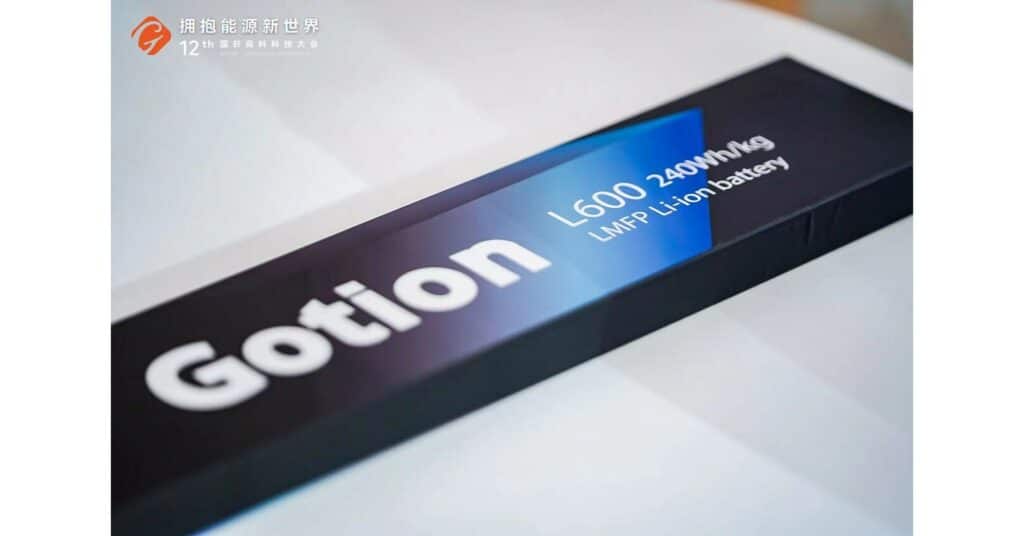
According to GHT, their LMFP battery offers 1,000 km of autonomy, a fast charging time of only 18 minutes, and a lifespan of 4,000 charge-discharge cycles.
Doing the math: 1,000 km x 4,000 charges equals an impressive 4,000,000 kilometres, easily outpacing the median life expectancy of any EV.
To achieve this significant milestone, Gotion re-engineered the chemistry of the battery. Standard Lithium-Iron-Phosphate (LFP) batteries are safe and cheap but have a lower energy density, meaning more weight and less range. By adding manganese (Mn) to the mix, Gotion increased the voltage. This change allowed more energy storage in the same space without the fire risks associated with traditional nickel-based (NCM) batteries.
Characteristics of the L600 LMFP
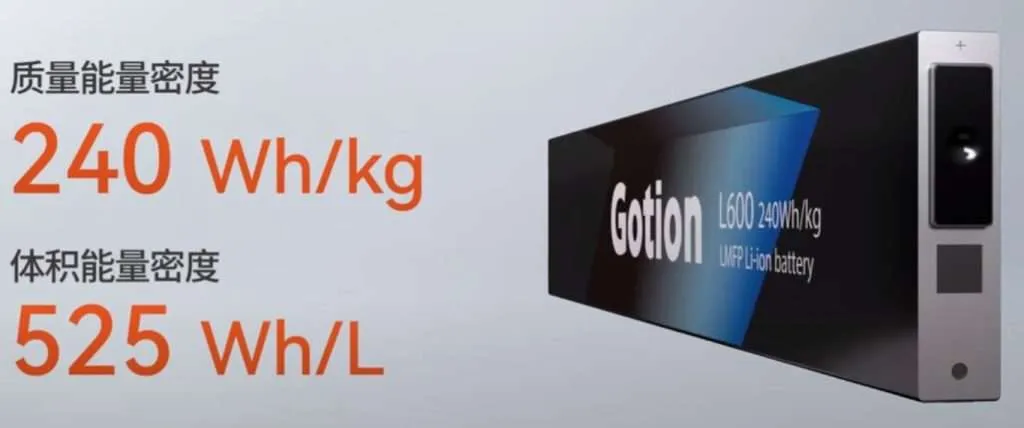
● Cell energy density: 240 Wh/kg (comparable to high-end Tesla cells)
● Pack energy density: 190 Wh/kg
● Cycle life: 4,000 cycles (around 4 million km over a lifetime)
● Fast charging: 10% to 80% in approximately 18 minutes
● Safety: Thermally stable up to 1,200°C; zero thermal propagation.
Beyond chemistry, Gotion also redesigned the entire “box” in which the battery sits.
● Minimalistic Wiring: The internal wiring went from 303 metres to only 80 metres.
● Sandwich Cooling: A double-sided liquid cooling system keeps cells at an ideal temperature during both extreme driving and ultra-fast charging.
● Weight Reduction: The structural parts of the pack were reduced by 45%, and the overall weight by 32%.
Fast Forward to 2026
As of early 2026, Gotion High Tech began mass production of its Unified Cells (which include the L600 LMFP chemistry) at its specialised facility in Hefei. Beyond China, Gotion is scaling up manufacturing at its plant in Göttingen, Germany, and its massive $2 billion gigafactory in Manteno, Illinois, is scheduled to reach full capacity by 2027.
It’s important to note that Volkswagen is Gotion High Tech’s largest shareholder. Both companies have a strategic agreement (2026-2032) in which GHT will be the main supplier for the Unified Cell, the standard format designed to fit 80% of all future VW Group vehicles.
Expected Vehicles Featuring LMFP Battery Packs (2026–2028)
While manufacturers keep details proprietary until a car’s launch, the following brands and platforms are likely to be the primary homes for the 1,000 LMFP:
- Volkswagen ID.7 and the upcoming ID.4/ID.5 refreshes.
- Chery Exlantix ET
- IM Motors (SAIC and Alibaba) LS6 and L7
- JAC Yiwei 3
Summary of the “1,000 km” Timeline
While the battery is capable of 1,000 km, car manufacturers might choose to use smaller packs to keep vehicles lighter. You will probably see “1,000 km” as a premium option, while the standard versions offer 600-700 km using the same LMFP technology.
This innovation is expected to be 20–25% cheaper than high-nickel batteries in luxury EVs today. And with a 4,000-cycle lifespan, the battery easily outlasts the car. Given that, charging it only once a week (in case you’re an Uber driver), it could last over 70 years.
Now, in addition to the clear benefits for cars, consider the possibility of using LMFP in your smartphone – you could potentially charge it only twice a year. A UPS might keep your computer off the grid for months, and larger LMFP batteries even supply energy after dark to entire communities. The only problem here is lithium.
Lithium is finite. There will come a point when we’ll have depleted all the reserves. What would happen next? We have the technology, so it’d be clever to mass-produce alternative energy units, such as the oxygen-ion ones – called forever batteries – or the salt variants, which are being developed in Germany. And leave electricity generation to hydrogen or nuclear power, not solar (which is set to create billions of tonnes of waste in the next few years with little to no material recovery).
To close this article, remember that cars are not the main source of pollution. Indeed, steel and cement production are the top polluters. So, we should aim the spotlight at clean electricity generation.