The Renewable Energy Transition: 5 Hidden Costs and Hard Truths

This ‘green’ switch promises cleaner power, but below its surface it carries environmental, economic, and social costs that deserve closer scrutiny

The point of switching to renewables is to combat climate change, largely driven by our use and abuse of fossil fuels. The benefits of this shift are clear: reducing greenhouse gas emissions, improving air quality, promoting sustainability, and reducing long-term climate risk.

Yet no energy system is without trade-offs.

Behind the promise of cleaner power lie substantial environmental and social costs that are often underexamined and may lead to many unforeseen perils. It doesn’t mean we are against the full adoption of clean energy; au contraire. But we must consider and understand all the advantages and disadvantages this switch could bring.

Here, we report five of the most relevant challenges and why green energy may not be as green as it seems – in certain aspects.

Grid Stability and Intermittency

Amongst the primary technical challenges is that solar and wind are non-dispatchable, meaning they cannot be switched on or off to meet demand. They depend on fluctuating weather – wind turbines only produce power when the wind blows, and solar panels only convert rays to electricity during daylight hours.

Another challenge is that, until today, traditional grids rely on the rotational inertia of massive synchronous generators in fossil fuel or nuclear plants to keep frequency stable. Because solar and wind use power electronics, they lack this natural motion, which may lead to instability if not managed with advanced storage or grid-forming technologies.

Furthermore, grid congestion can happen in areas with high renewable penetration during peak production periods, leading to overloads.

Environmental and Social Impacts of Hydropower

The negative impact of hydropower

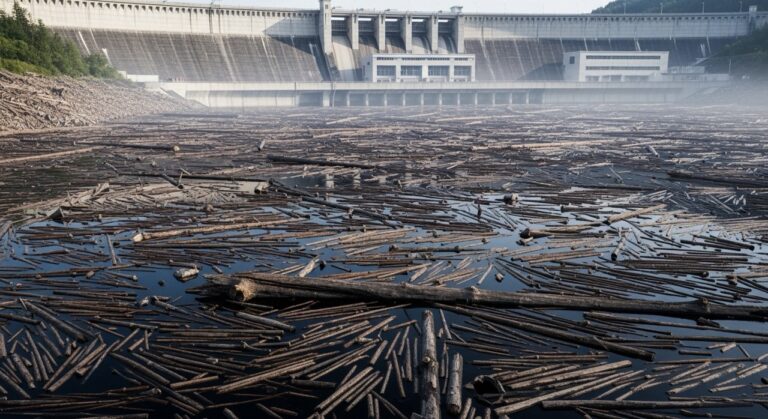
Marketed as a sustainable solution, large-scale hydropower has significant drawbacks. The most worrying one, which you may not even know, is greenhouse gas emissions. Reservoirs can be a major source of methane and carbon dioxide as flooded vegetation decays underwater. Under specific circumstances, they may cause more warming than coal-fired power stations.

According to the Environmental Defence Fund (EDF), methane emissions, packing over 80 times the warming force of CO₂, are responsible for at least 25% of today’s global warming. Moreover, the 2021 Intergovernmental Panel on Climate Change (IPCC) report showed that cutting methane emissions is the most urgent step we must take to slow the rate of a “Thermageddon”.

Another negative factor of hydropower is the evident ecological destruction. Dams disrupt rivers, ‘living corridors’ that feed forests, fisheries, coastal ecosystems, and farmlands. They also raise water temperatures, degrade water quality, and block fish migration. All these environmental alterations triggered an 84% decline in freshwater populations since 1970.

And finally, we’ve got human rights and sources of income. The 2000 WCD report and the World Bank say that large dams have displaced an estimated 40-80 million people, affecting the food security and livelihoods of roughly 472 million people living downstream. At the same time, hydropower companies often violate the rights of indigenous peoples to their lands, territories, resources, governance, cultural integrity, and the right to free, prior, and informed consent (FPIC).

Here’s an example. On the night of 2nd March 2016, gunmen killed indigenous rights activist Berta Caceres in her home in La Esperanza, Honduras. She was opposing the construction of the Agua Zarca hydroelectric dam. In 2021, a Honduran court convicted David Castillo, the former CEO of dam company DESA, as a co-author of the murder.
Waste Management and Toxic Materials

Waste management

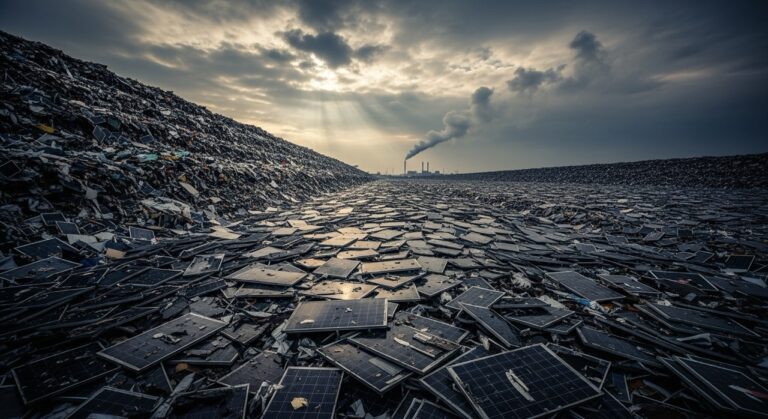
Disposing of renewable infrastructure presents a “growing silent waste crisis”. Let’s start with solar energy. PV panels typically last 25 to 30 years. And their cumulative global scrap could reach an astonishing 160 million metric tonnes by 2050 – before considering the potential for recycling. That’s twice the weight of the Great Wall of China or 8,000 Eiffel Towers.

While mostly glass and aluminium, roughly 5% of PV panels contain toxic substances such as lead and cadmium, which require specialised recycling streams to prevent leaching.

Regardless of the nature of the panels, they are difficult to recycle in full because of the complexity of their engineering. At this moment, only 10% of a solar panel’s waste is recycled.

As for wind energy, around 78% of installed turbine blades – made of non-biodegradable fibreglass-reinforced composites – are projected to end up in landfills or incineration because they are difficult to recycle. A solution lies in blades that are easier and cheaper to break down into reusable or raw materials. Initiatives such as the ZEBRA Project Consortium from France or DecomBlades from Denmark have taken steps towards a scalable introduction of repurposable models. Thus far, these programmes confirm the technical feasibility of designing a 100% recyclable blade. But it is still too expensive to reach broad commercialisation.

The next point is mineral intensity. Clean energy technologies demand substantially more minerals than their fossil fuel counterparts. For instance, a typical electric car requires six times the mineral input of an internal combustion engine (ICE) vehicle. And an offshore wind farm needs a whopping nine times more mineral resources than a gas-fired plant. Since 2010, the minerals needed for a new unit of power generation capacity have increased by 50%.

Impacts on Wildlife and Landscapes

Impact on wildlife

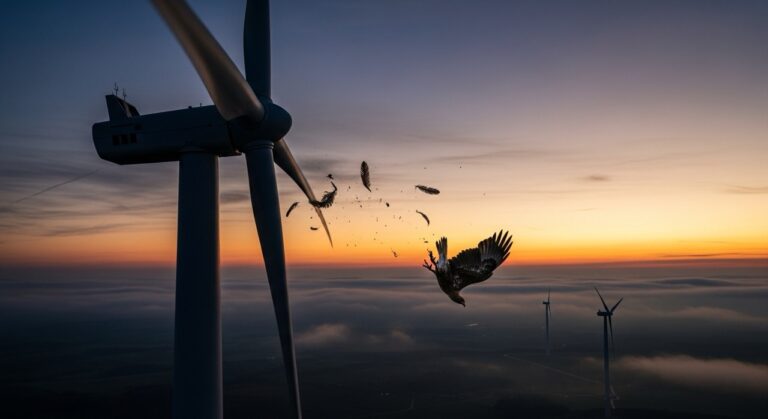
Wind turbines are associated with bird and bat deaths due to collisions. In 2021, the American Bird Conservancy calculated that wind turbines kill about 681,000 birds each year in the US. Other estimates for 2022 range from 200,000 to 1.2 million. In comparison, building strikes accounted for an estimated 365 to 988 million bird deaths in 2014, while domestic cats killed between 1.3 billion and 4 billion birds in 2013.

Likewise, solar farms pose a risk of collisions because of the “lake effect” – birds mistake panels for bodies of water. On their side, nuclear power plants affect birds through their hazardous pollution at uranium mines and impacts with draught cooling structures.

Now, let’s address the land-use conflicts point. There’s a difference between “footprint” and “spacing”. Footprint area represents land covered by infrastructure, while spacing area is the entire space within the perimeter of a production site. To illustrate, for wind energy, the footprint is where the turbine pads and access roads sit, whereas the spacing is the zone of the whole wind farm. While the overall impact is much lighter than fossil fuel infrastructure, renewables have a high land-use intensity per terawatt-hour compared to nuclear power.

Socio-Economic and Ethical Challenges

Of the 700 companies, unions, and institutions in the IEA’s Energy Employment Survey, more than half reported serious hiring issues and a lack of a skilled workforce. This is especially true for electricians, pipefitters, line staff, plant operators, and nuclear engineers. This scenario threatens to slow down the development of energy infrastructure and raise costs. Also, a retiring labour pool is adding to the strain, with 2.4 workers nearing retirement for every new entrant under 25.

On supply chain ethics, organisations such as the Breakthrough Institute claim that the production of many solar panelsand their components in China comes from “dependence” on “unethical production”. In 2022, a report from the US special rapporteur on contemporary forms of slavery stated that it was “reasonable to conclude that forced labour among Uyghur, Kazakh, and other ethnic minorities in sectors such as agriculture and manufacturing has been occurring” in Xinjiang.

A question for you: could the main problem be overconsumption? We are using more resources than the Earth can regenerate. This is known as Ecological Overshoot. As the population grows, so will energy consumption, the number of buildings, cars, and waste, and the amount of plastics in the oceans and air, while the quantity of land for farming and water for drinking will decrease. Isn’t the issue that there are too many people, and soon we will reach a point where there won’t be enough for everyone?

Leave a Reply