Right now, the tech industry is undergoing a massive market correction as leading firms lose trillions of dollars in collective value due to unsustainable spending. AI companies are investing hundreds of billions into infrastructure, yet investors are not seeing immediate profits and may worry about the potential for an economic bubble.
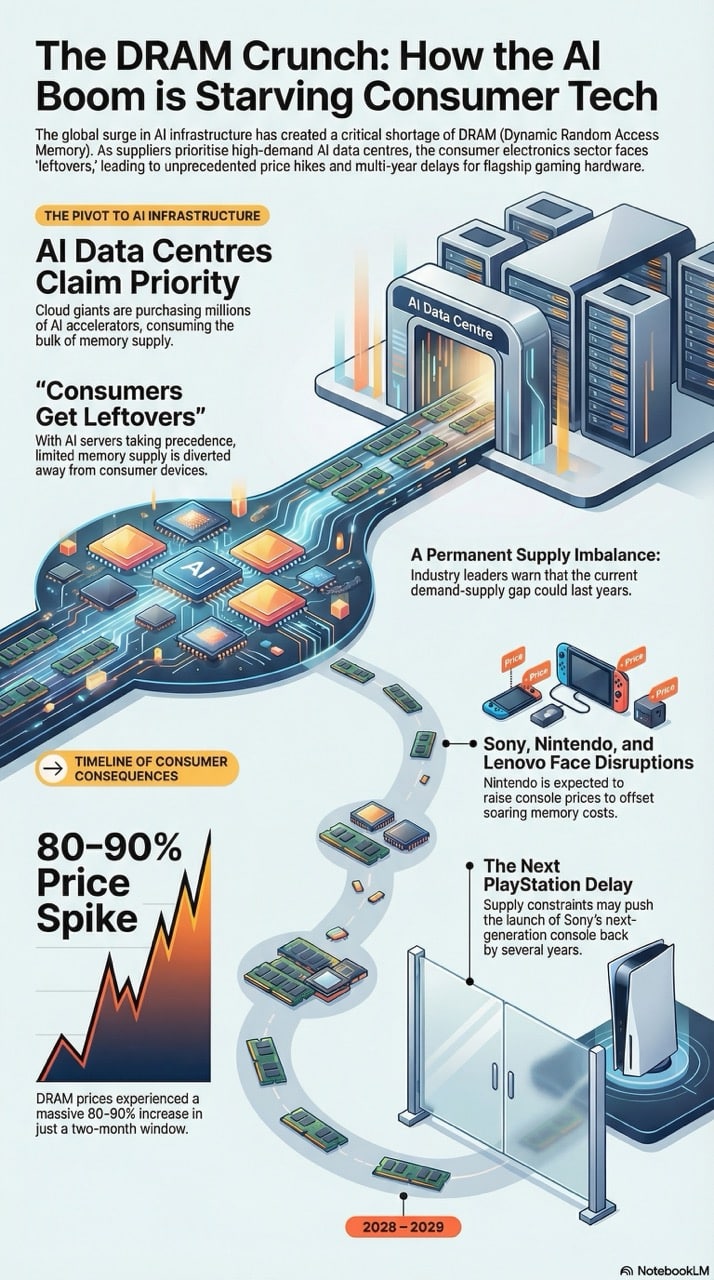
Apart from the financial strain, there is a severe global shortage of memory chips, most of which are being diverted from consumer electronics and cars to power massive data centres, causing delays and price increases in this large industrial sector.
Future success in this scenario will depend on navigating resource scarcity while transforming Artificial Intelligence into a profitable business model. At the moment, it doesn’t look like the best investment option.
The Cost of Hype and the Global Chip Crisis
Big Tech companies have seen a staggering decline in market valuation, actively losing over $1.3 trillion in combined value since January this year. This downturn is driven by several critical factors, including:
Gigantic Infrastructure Costs and the Lack of Significant Profit
The AI race is one of the most expensive technological battles in history. And by expensive, we mean astronomical. Data centres, specialised chips, and infrastructure are costing these firms hundreds of billions. For instance, Amazon plans to increase its spending by more than 50%, reaching $200 billion, while Alphabet plans to spend around $185 billion. The issue is that investors are nervous because they haven’t seen significant profits yet, despite the staggering investment. Will this level of spending ever truly pay off? Moreover, since AI costs are too high, ROI may take years to materialise, and the intense competition might eventually shrink profit margins.
Critical Supply Chain Bottlenecks: The AI Hunger
A major threat to the AI industry is a global shortage of memory chips (DRAM), which are the backbone of almost every modern device. Companies like OpenAI and cloud giants are purchasing millions of AI accelerators to build out their infrastructure. And these accelerators devour millions of memory chips to work effectively.
Because of the scale of these orders, AI servers are given priority by manufacturers. This means that the limited supply of DRAM is funnelled towards data centres first, leaving the “leftovers” for the consumer electronics market – smartphones, laptops, cars, Nintendo consoles – leading prices to shoot up by 80% to 90% (based on projections/trends noted for late 2025/early 2026). For those who love video games, this is terrible news, since Sony Group may delay the launch of its next PlayStation until as late as 2028 or 2029. Another example is Lenovo, which has warned that this supply-demand imbalance is not temporary and could last for several years.
Circular Money and Vanishing Deals
There’s growing concern that money in the AI sector is simply “going in circles” rather than generating external profit. For instance, a high-profile $100 billion mega-deal between OpenAI and Nvidia – celebrated with fanfare and fireworks – seemingly “disappeared into thin air” without further development. Such an apparent failed transaction could justify investor fears that the current AI hype might be a bubble. Billion-dollar deals between AI companies often lack the necessary follow-through to produce sustainable business results. Thus, the “disappearance” of this specific deal has contributed to the broader market anxiety that has seen Big Tech lose over $1.3 trillion in combined value since January.
Yet, amid this chaos of vanished deals and evaporating value, some of the most powerful voices in finance still insist there is no bubble at all.
When the Largest Investor on Earth Declares “It’s Not a Bubble”

There’s always that one guy at the party who insists everything is fine as the ceiling starts to crack. In the AI story, that guy is Larry Fink. BlackRock’s chief, who presides over $14 trillion in assets, has become the unofficial spiritual leader of the “this is not a bubble” congregation on X. If only markets worked like that.
The people who make a living studying manias – long-cycle investors, central banks, macroeconomists – didn’t quietly pack up their charts and go home when Fink posted on social media.
A systematic review of recent research and policy papers concludes that we are in a messy both/and moment: AI as a technology almost certainly has real, long-run economic value, but segments of the AI-exposed equity market show classic bubble fingerprints. Veteran bubble-watchers Jeremy Grantham and Edward Chancellor argue that the current AI boom may end up as “the greatest capital investment bubble of all time.” A structured look at reports from central banks, the IMF, and major research outfits finds repeated, explicit comparisons with the late-1990s dot-com boom: richly valued platforms with unproven business models, overlapping capital flows amongst the same small circle of tech giants, and a striking absence of aggregate productivity growth to justify the price action.
Other voices have already expressed their views. Around them, bank bosses and tech CEOs muttering the same caveats: Goldman Sachs warns that “a lot of capital” deployed into AI is unlikely to earn its cost; Jeff Bezos has described the current AI environment as having bubble-like characteristics; and even some AI-lab leaders admit that plenty of money will be lost in this phase.
So no, Larry Fink has not “silenced” anyone with his X posts. He’s given one side of the argument the kind of gleaming, authoritative soundbite it craves. The rest of us still have to live with the tension. So, pretending that a single billionaire’s conviction can make that tension disappear isn’t analysis – it’s just wishful thinking dressed up as bravado.
Big Tech Accused of AI ‘Greenwashing’

From Generative AI to Agentic AI: Businesses Advancing the Automation Frontier

Understanding Blockchain and Its Real-World Applications

BYD’s Five-Minute EV Charging Now Has a Faster Rival: CATL’s Shenxing 3 Battery
BYD’s Five-Minute Charging Breakthrough: Blade Battery 2.0
Salt Batteries Breakthrough: A Sodium-Based Solution for Grid-Scale Energy
After all this, one thing is clear: there was a time when stock prices were driven by promises alone, but not anymore. The next phase of the AI race will be judged on actual profits rather than hype, which is a much harder game for these tech giants to play compared to the initial era of AI excitement. No doubt, Artificial Intelligence is here to stay, and we know that. However, the current loss in value reflects that the path to profitability is way longer and more expensive than anticipated. The “easy money” time is over.