A comprehensive review conducted by scientists from Gannan Medical University in China revealed that micro- and nanoplastics (MPs and NPs) are directly linked to the development of Parkinson’s disease.
Their work, published in the journal NPJ Parkinson’s Disease in 2026, synthesised data from over 100 previous studies, including those from animal research, lab experiments, and computational models. Key findings from the analysis include:
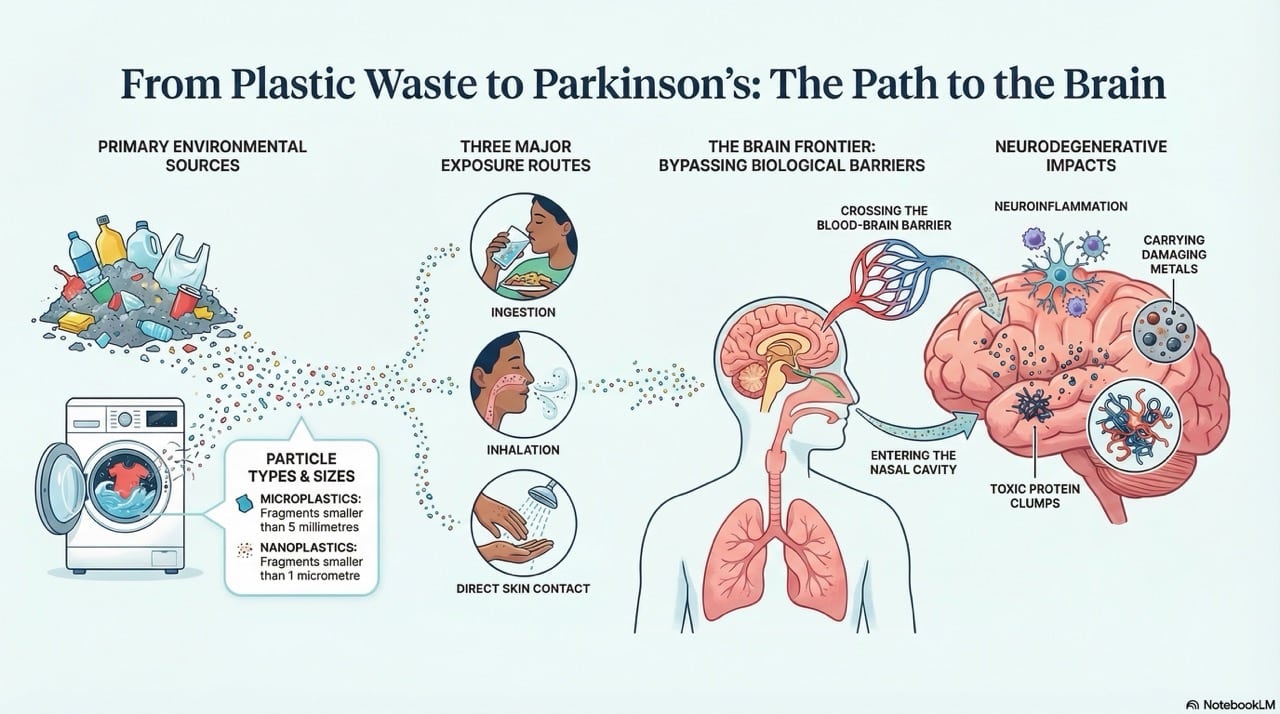
Pathways to the Brain
Researchers identified that these tiny plastic fragments enter the human body via ingestion, inhalation, and skin contact. Once inside, they breach biological barriers, such as the blood-brain barrier, or enter through nerve cells in the nasal cavity and accumulate in the brain.
Mechanisms of Damage
Evidence suggests that accumulated plastics trigger processes associated with Parkinson’s, such as:
- Encouraging the formation of toxic alpha-synuclein protein clumps
- Driving neuroinflammation and disrupting communication between the brain and the gut
- Transporting damaging metals into the brain (known as ferroptosis)
A New Ecological Danger
MPs and NPs constitute a “novel environmental hazard” for the pathogenesis of Parkinson’s disease.
Scientific Limitations
While the evidence is intriguing, the authors emphasise that human toxicity remains “incompletely characterised” since most current data stem from animal or laboratory settings.
Because of these findings, the researchers are calling for systematic future research to understand how particular plastic properties influence disease pathways, as well as urgent global action to reduce pollution and improve waste management.
Table of Contents
- Pathways to the Brain
- Mechanisms of Damage
- A New Ecological Danger
- Scientific Limitations
- How Do Size and Shape Affect Plastic Toxicity in Organs?
- What is Ferroptosis? How Do Plastics Trigger It?
- How Do Microplastics Contribute to Antimicrobial Resistance?
- What Other Health Risks Are Associated with Micro- and Nanoplastics?
- A Glimmer of Hope: The Teenager Taking on Microplastics

How Do Size and Shape Affect Plastic Toxicity in Organs?
Both are critical factors, but the specific ways they disturb human health are still being investigated and are not fully understood.
Size and Biological Barriers
The diameter of the particles determines their ability to move through the body. To illustrate, nanoplastics (smaller than one micrometre) and microplastics (smaller than 5 millimetres) are small enough to pass through any organic filters our bodies might have, allowing them to leave the digestive or respiratory tracts and accumulate in multiple organs – the brain included.
Influence on Disease Pathways
Other factors like the particle’s shape, along with its surface charge, polymer type, and degradation state, are also believed to dictate how the particles encourage the formation of toxic protein clumps – specifically alpha-synuclein, a characteristic feature of brains affected by Parkinson’s – and drive neuroinflammation (another damage historically connected to the progression of the disease).
What is Ferroptosis? How Do Plastics Trigger It?
As a process of brain deterioration, ferroptosis occurs when iron levels rise within the cell, triggering the Fenton reaction, which produces highly reactive free radicals. These radicals attack the lipids (fats) that make up the cell’s protective outer membrane. MPs and NPs induce this process by acting as carriers, transporting harmful metals directly into the nervous system, where they accumulate and lead to cellular damage.
Researchers noted this as one of several ways plastic pollution may be fuelling the rising prevalence of Parkinson’s disease.
How Do Microplastics Contribute to Antimicrobial Resistance?
MPs in the environment serve as surfaces for bacteria to form biofilms. These dense bacterial communities ease horizontal gene transfer, making it possible for microorganisms to swap antibiotic-resistance genes.
Besides, plastics absorb and concentrate other environmental pollutants, particularly residual antibiotics. This results in a “selective pressure” where only pathogens with resistance traits survive, leading to the proliferation of resistant strains. And since MPs and NPs are omnipresent and mobile in water and air, they can move antibiotic immunity and genetic material across vast distances to new ecosystems.

What Other Health Risks Are Associated with Micro- and Nanoplastics?
Beyond the potential link to Parkinson’s disease, research shows that MPs and NPs pose several other significant physical threats as they accumulate in many organs throughout the body.
Emerging studies connect these pollutants to:
- Fertility Problems
- Cardiovascular Issues
- Cellular Damage
- Disruption of Biological Communication

Toxic Gaslighting: How 3M Executives Convinced a Scientist the Forever Chemicals She Found in Human Blood Were Safe

Alcohol Causes Cancer, and Less Than 1 Drink Can Increase Your Risk − A Cancer Biologist Explains How

How a Health Administration Degree Opens Doors to Leadership in Healthcare
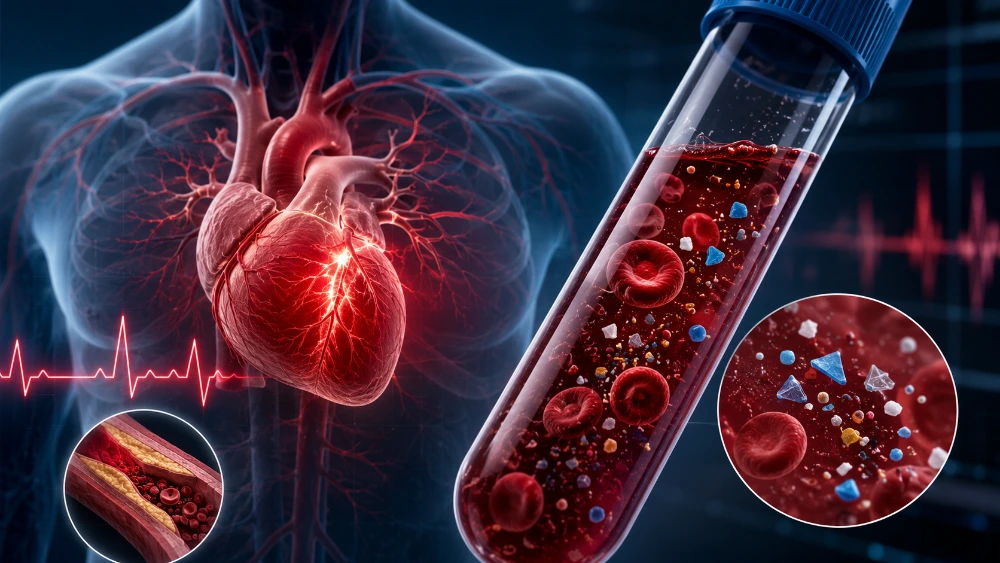
Do Patients Who Suffer Heart Attack Have More Micro and Nanoplastic in Their Blood? New Study Assessed

Can Ozempic Prevent Cancer? A Doctor Explains Why the Headlines Are Easy to Misread

The Government Knows The Real Climate Threat. Why Is It Hiding It?
We don’t know what happens when people are exposed to plastics their whole lives – still unknown. But strong evidence linking micro- and nanoplastics to serious diseases demands a full scientific review. Discovering a potential link to Parkinson’s is merely the start of further investigation. But not enough. Invisible plastic particles keep building up in our bodies, in the world, and in our minds.
But if the risks are becoming harder to ignore, can anything be done to stop microplastics before they reach us?
A Glimmer of Hope: The Teenager Taking on Microplastics

Mia Heller, a high school student from Virginia, has developed a filtration system that does something most existing technologies struggle to achieve: it removes microplastics efficiently, affordably, and at scale.
Her approach doesn’t rely on brute force or expensive chemical processes. Instead, it uses ferrofluid, a magnetic liquid that binds to microplastic particles in water. Once attached, those particles can be pulled out using magnets, leaving cleaner water behind.
Think of it as turning invisible pollution into something you can physically extract.
In controlled tests, Heller’s prototype removed up to 96% of microplastics from water, while also recycling around 87% of the ferrofluid used in the process. And that’s the detail that matters: a system that isn’t just effective but sustainable and potentially scalable.
And here’s where it gets interesting. Most current filtration systems are either:
- Too expensive
- Too energy-intensive
- Too complex for widespread use, especially in lower-income regions
Heller’s design, on the other hand, uses relatively simple materials (including plant-based oil as part of the ferrofluid) and points towards a future where microplastic filtration could become accessible rather than elite infrastructure.
Now, let’s consider the implications.
If scientists are concerned that MPs may contribute to neurological disorders – including Parkinson’s – then technologies like this aren’t just environmental innovations. They’re potentially preventative healthcare tools disguised as water filters.
Of course, we’re not there yet. Heller’s system is still a prototype, not something sitting under your kitchen sink. Scaling it to municipal systems or global infrastructure will require time, funding, and industrial backing.
But it does something arguably more important right now: it shifts the narrative.
From inevitability to intervention. From contamination to control.
And perhaps most provocatively, it raises a question: if a teenager can remove 96% of microplastics from water, what exactly is stopping the rest of us?
We hope it’s not too late to understand that using too many plastics will destroy our society and the human race as a whole. It’s possible to happen. The next generation may have low IQs and deformities in the not-too-distant future, and for what – to drink water from a plastic bottle because it’s “convenient”?



2 thoughts on “Are Parkinson’s Cases Rising Due to Microplastics? Scientists Say “Maybe Yes””