Something fundamental shifted in enterprise technology between 2023 and 2025. Businesses stopped asking AI to generate things and started asking it to do things. The simple and polite chatbot, which offers only passive text-generating assistance, is giving way to a new class of autonomous system: the AI agent. This digital worker doesn’t wait for any prompt. It plans, decides, executes, and adapts. Such a transition from Generative AI to Agentic AI is the most significant business transformation of this decade, and the data confirms it is no longer hype but operational reality.
According to McKinsey’s 2025 State of AI survey, which covered 1,993 respondents across 105 countries, 88% of organisations now use artificial intelligence in at least one business function, up from 78% the previous year. More tellingly, 62% of those organisations are already experimenting with AI agents, and 23% say they are scaling agentic systems for more than one role.
Today’s story shows how the world went from asking AI to write an email to requesting it to run a supply chain.
Generative AI: The Spark That Started Everything – Understanding the Shift

Generative AI (GenAI) emerged as a headline-grabbing force in 2022, with Large Language Models (LLMs) such as ChatGPT boasting a surreal ability to produce human-like text, images, code, and analysis on demand. Different types of businesses rapidly embedded it into their workflows to draft marketing copy, summarise documents, generate code snippets, or answer customer FAQs. Real and measurable, however, the impact was fundamentally reactive.
GenAI produces outputs only when prompted. It sits and waits. A human still has to start the action, review the result, and then carry out the next move. Nevertheless, this makes GenAI an invaluable productivity multiplier.
Nonetheless, GenAI isn’t prepared for most high-value workflows, which are not single-step. For instance, onboarding new suppliers, processing an insurance claim, closing a sales deal, or responding to a cybersecurity threat all require dozens of coordinated actions across multiple systems, teams, and data sources. While GenAI can help a person do each of those steps faster, it cannot do them by itself.
That gap is what Agentic AI was built to close.
Agentic AI: From Suggestion to Execution
Agentic AI refers to autonomous AI systems that do more than just generate outputs; they perceive their environment, set goals, plan sequences of actions, use tools, execute those actions across real software ecosystems, and adapt when something goes wrong. And they handle everything with minimal or no human intervention between steps. In essence, a GenAI chatbot is a question-and-answer engine, while an AI agent is a goal-seeking executor. Core capabilities that separate an AI agent from a sophisticated chatbot are the following:
- Memory: Retains context across sessions and tasks, not only within a single conversation.
- Tool Use: Interacts with the environment by calling external APIs, accessing databases, browsing the web, writing code, or using enterprise software.
- Planning: An AI agent decomposes a high-level goal into a sequence of sub-tasks.
- Execution Loops: Observes the result of each action, evaluates progress, and refines the plan based on the findings.
- Multi-Agent Collaboration: Coordinates with other specialised agents to execute complex workflows.
To underscore the point further, if GenAI is an intelligent consultant who gives you recommendations in a meeting, Agentic AI is the competent employee who receives the brief and then goes off and does the work, only returning when it needs a decision that requires human judgement.
The Technology That Made Agents Possible
Several converging breakthroughs enabled this shift at enterprise scale in 2024 and 2025. Large Action Models(LAMs) – the successors to LLMs – have been trained not only to generate text but also to perform real-world actions across software environments. Integration frameworks like LangChain, CrewAI, and Microsoft’s AutoGen emerged, allowing agents to connect in perfect sync with ERPs, CRMs, and SaaS tools.
For instance, Google’s Agent2Agent protocol, now donated to the Linux Foundation, enables agents built on different platforms to communicate and collaborate. Meanwhile, Microsoft introduced the Model Context Protocol (MCP), granting agents integration with over 1,400 systems, including Dataverse and Dynamics 365.
As a result, the effect has been cumulative. Each breakthrough lowered the activation energy for building and deploying agents, leading to more investment and better tools while lowering the barrier further. Gartner’s forecastcaptures the trajectory in a nutshell: task-specific AI agents were integrated into less than 5% of enterprise applications in 2025, but that figure might reach 40% by the end of 2026.
Market Size and Growth Path: The Numbers

The agent AI market is expanding at a speed that makes even seasoned technology analysts take a sharp breath. Multiple research firms converge on figures that tell a consistent story of explosive expansion:
| Research Firm | 2025 Market Value | Projected Value | CAGR |
|---|---|---|---|
| DataM Intelligence | $4.54 billion | $98.26 billion (2033) | 46.87% |
| Grand View Research | $7.63 billion | $182.97 billion (2033) | 49.6% |
| Fortune Business Insights | $7.29 billion | $139.19 billion (2034) | 40.5% |
| Mordor Intelligence | $9.89 billion (2026) | $57.42 billion (2031) | 42.14% |
Variations in figures reflect different methodological scopes and definitions, but the direction is unequivocal. For instance, BCG estimates the market for AI agents will grow at a 45% CAGR (Compound Annual Growth Rate) over the next five years. From IBM’s and Salesforce’s perspectives, over one billion agents are projected to be operational by 2026.
Enterprise Adoption: What the Surveys Say
The implementation picture that emerges from the major 2025 surveys is one of accelerating deployment tempered by real-world friction.
PwC (May 2025, 300 senior executives)
- 79% affirm their companies are adopting AI agents
- 88% plan to increase AI-related budgets in the upcoming year because of agentic AI
- 66% of current users affirm they are delivering measurable value through increased productivity
- 67% agreed that AI agents will drastically transform existing roles in 2027
- 46% are concerned their company may be falling behind competitors.
SS&C Blue Prism (Global Enterprise AI Survey 2025)
- 29% of organisations are already using agentic AI
- 44% plan to implement it over the next 12 months
- Only 2% are not considering deploying automation
- 78% of leaders don’t fully trust agentic AI to work by itself
- 69% of AI projects never go live
- 94% view process orchestration as a crucial part of the technology stack for successful AI deployment.
Lyzr AI (State of AI Agents in Enterprise 2025)
- 64% of AI agent adoption centres on automation
- 62% of enterprises exploring AI agents lack a clear starting point
- 32% of businesses stall after a pilot and never reach production
- Companies estimate up to 50% efficiency gains in customer service, sales, and HR from agent deployments.
Gartner (2025 Forecasts)
- By 2028, AI agents will make at least 15% of routine work decisions independently, an increase from 0% in 2024
- Also, by 2028, 33% of enterprise software applications are set to integrate agentic AI
- By the end of 2027, companies will cancel over 40% of agentic AI projects due to escalating costs and unclear business value.
Microsoft Build 2025
- Over 230,000 organisations – including 90% of the Fortune 500 – have already used Copilot Studio to build AI agents and automations
- 15 million developers are using GitHub Copilot.
Based on an MIT study, 95% of GenAI pilots fail to deliver measurable P&L (Profit and Loss) impact. But this is no reason to dismiss Agentic AI. Instead, pursue it with strategic clarity rather than FOMO (Fear of Missing Out).
“Most agentic AI projects right now are early-stage experiments or proofs of concept that are mostly driven by hype and are often misapplied.” — Anushree Verma
Industry by Industry: Real-World Cases
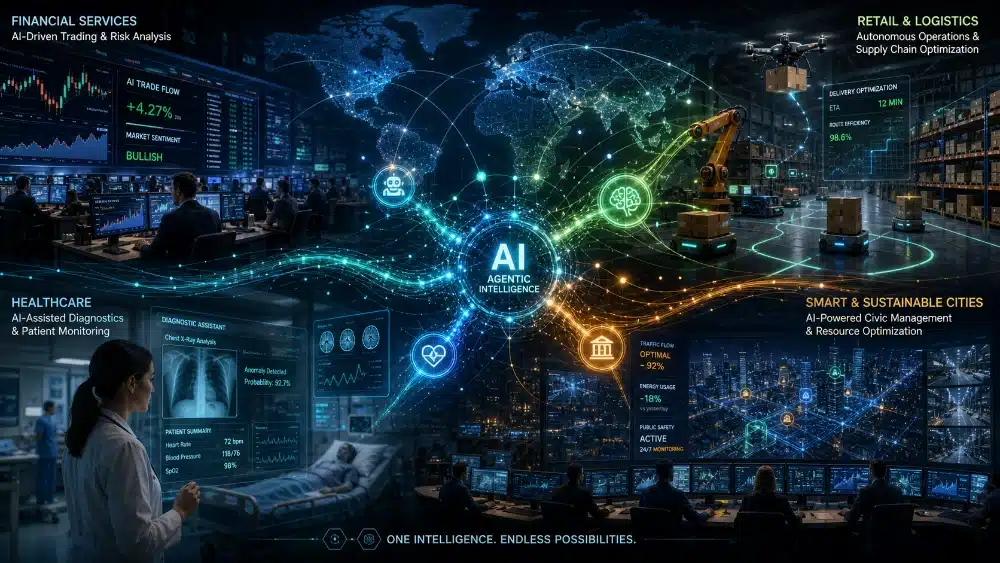
Financial Services: Speed, Scale, and Savings
Finance ranked amongst the earliest and most aggressive adopters of AI agents, fuelled by an obvious fact: in financial services, speed and accuracy at scale are not just competitive advantages; they are the business model.
Klarna is one of the most cited case studies in the agentic AI conversation, and for good reason. The Swedish FinTech deployed a customer-support AI agent that now handles 2.3 million conversations per month, achieves an 83% autonomous resolution rate, and has replaced the workload of around 700 full-time support agents. In its first year, the system delivered an 8x return on investment and generated an estimated $40 million in ongoing annual savings.
JPMorgan Chase has deployed over 200 AI trading and analysis agents that monitor markets 24/7, managing and analysing billions in assets. The bank reports a 40% efficiency gain across research functions and $150 million in yearly cost reduction. JPMorgan’s programme spans not only trading but also legal document interpretation, fraud detection, and risk management – a sign that agentic workflows are being embedded throughout the entire value chain, not just in one isolated department.
Spain’s largest bank, CaixaBank, showcased at Salesforce Dreamforce 2025 how an AI agent collects key customer details – such as income, desired loan amount, and location – and routes mortgage applications through a streamlined workflow, reducing a multi-day process to a matter of clicks.
Retail and E-Commerce: The Supply Chain Metamorphosis
Retail offers a vivid illustration of how agents move beyond chatbots. When Walmart’s customers see an item back in stock right when they need it, they don’t know that an AI agent predicted that demand and triggered a restocking order on its own. Walmart has deployed over 1,000 supply chain AI agents that optimise inventory, coordinate logistics, and adjust to disruptions in real time. As a result, the company reports $500 million in annual savings (representing a 15% reduction in costs) and a 60% drop in stock-outs.
Now, let’s look at Shopify. Its AI agents handle over 50 million merchant queries per month, resolving 70% of tier-1 support issues, saving retailers an estimated 5 to 10 hours a week, and achieving a 4.5 out of 5 customer satisfaction rating.
Next, we have Williams Sonoma’s AI agent Olive. It combines client data and product attributes to deliver personalised recommendations and cooking tips, blending WS’s signature in-store experience with digital scale. Pandora follows a similar path with Gemma, an AI shopping agent that opens conversations by asking about the recipient and occasion. By drawing on order history and demographic data, Gemma delivers suggestions in the brand’s distinct voice. And Best Buy is resolving customer service issues up to 90 seconds faster using AI-powered virtual assistants.
Healthcare: From Admin to Diagnostics
In the health sector, the stakes are literally life and death, making AI’s progress both more impressive and subject to stricter governance. Here you’ll find a few examples.
Cedars-Sinai Medical Center in Los Angeles deployed an AI agent called CS Connect for patient intake and preliminary symptom triage. More than 42,000 patients have used it, and 77% of AI-suggested treatment plans were rated optimal, outperforming some human assessments in accuracy and speed.
At Dreamforce 2025, UChicago Medicine showed how patients use an AI assistant to book appointments, clarify procedures, and manage billing. A “lock-and-key” model ensures sensitive personal data is never exposed without verified authentication, maintaining HIPAA (Health Insurance Portability and Accountability Act) compliance.
One more case is Alberta Health Services in Canada. It embedded AI automation so deeply into its workflows that it freed the equivalent of 238 years of human work over a short deployment period, according to SS&C Blue Prism. Finally, a Stanford and MIT-backed virtual AI laboratory – where multiple AI-powered “scientists” collaborated as agents – generated 92 nanobodies targeting SARS-CoV-2, with over 90% binding to the virus in validation studies. That is agentic AI in research mode – not just helping researchers but conducting experiments.
Technology and Software Development
Microsoft’s transformation of its Copilot suite from a generative assistant to a full agentic platform is the most visible enterprise use case in the world. At Microsoft Ignite 2025, the company introduced Agent 365 – a centralised governance control plane for AI agents – alongside an expanded ‘computer use’ capability that allows assistants to interact with graphical user interfaces across more than 1,400 integrated systems. Copilot agents now serve over 400 million users within Word, Excel, PowerPoint, Teams, and OneNote. With these tools, organisations report productivity gains of up to 30%.
On the Salesforce side, it announced Agentforce 360 at Dreamforce 2025, positioning it as the backbone of the agentic enterprise. The company reported 12,000 Agentforce customers, with Reddit using the platform to deflect a significant portion of support cases and OpenTable resolving a majority of enquiries on its own. Marc Benioff, Salesforce CEO, stated that AI now does half of the work at Salesforce itself.
Moving on, Google placed AI agents at the heart of its enterprise strategy, consolidating several AI products under the Gemini Enterprise brand, integrating Gemini into Salesforce’s Agentforce stack, and releasing governance and security features for agent deployments.
PepsiCo, working with Salesforce’s Agentforce and Slack, embedded agentic workflows into field service operations. For instance, technicians can upload images during calls and immediately receive AI-generated repair recommendations and sales opportunity alerts.
Dell Technologies used agentic workflow automation to speed up supplier onboarding, with real-time metrics connected to Tableau dashboards. FedEx uses Salesforce’s Data 360 platform to unify data across sales, marketing, operations, and customer records, managing over $2 trillion in commerce and identifying international shipping opportunities amongst domestic-only customers. And Cursor AI, the agentic coding assistant, reached $200 million in annual recurring revenue in 2025, reflecting the extraordinary demand for AI agents that write, test, and debug code.
Public Sector and Civic Government
Even governments have entered the agentic era. Take the City of Kyle in Texas, which merged emergency and city services into a single 311 contact number, with an AI agent handling everything except genuine emergencies. The result was a 10% reduction in daily interactions, with citizens resolving issues faster and frictionlessly. At the same time, Sullivan County in New York deployed a GenAI-powered virtual agent named “Saige”, resulting in a 56% decrease in inbound call volume. Capgemini’s 2025 research found that 90% of public organisations are planning to explore, pilot, or implement agentic AI within the next two to three years.
The Architecture of Agentic Enterprises: From Single- to Multi-Agent Swarms

Most early agentic deployments were single-agent: one AI system with one defined mission. The frontier in 2025 and 2026 is multi-agent orchestration – coordinated fleets of specialised agents working together to tackle complex, cross-functional workflows.
In retail, this looks like a network of experts covering demand forecasting, inventory management, pricing, and logistics coordination operating in concert and sharing data and passing tasks between themselves in real time. Likewise, SAP’s Joule AI Copilot operates this way across HR, CRM, and finance functions in unison, acting as what SAP describes as an enterprise-wide knowledge worker.
Microsoft’s multi-agent orchestration in Copilot supports “collaborative agent ecosystems” – a Researcher Agent feeding insights to a Project Manager Agent within a unified process. This architectural shift separates experimental deployment from genuine transformation.
The Role of Frameworks and Protocols
Several platforms have become the plumbing of the agentic business. LangChain and CrewAI allow developers to build and chain agents with relative ease. Another case, Google’s Agent2Agent (A2A) protocol, enables cross-platform communication, while Microsoft’s MCP connects agents to thousands of systems. PwC’s Agent OS platform, integrated with both Salesforce Agentforce and Google Agentspace, attempts to solve the coordination challenge at enterprise scale, enabling agents built on different platforms to communicate, share data, and escalate to humans appropriately.

Embedded Finance: How Contextual Banking Is Replacing Traditional Banks

The “Invisible Employee” Trap: 5 Surprising Realities of Proximity Bias in the Hybrid Era

The Truth About Skills & Labour Shortages: Real Crisis or Corporate Fiction?
Understanding Blockchain and Its Real-World Applications

How to Make Big Financial Changes in Just 30 Days and Build Momentum

How to Help Your Customers Feel Like a Community
The Risks, Challenges, and the Governance Gap: Where Projects Are Failing
The failure rate for agentic AI deployments is alarmingly high. As stated by SS&C Blue Prism’s global survey, 69% of AI projects never make it into live operational use. Gartner forecasts that over 40% of current agentic initiatives will be cancelled by 2026, citing rising costs, unclear ROI, and inadequate risk controls. Furthermore, Gartner warned of widespread “agent washing”, where vendors rebrand basic chatbots or rule-based assistants as agentic AI, lacking the genuine autonomous capabilities the term implies.
Underlying causes of collapse are structural:
- 44% of organisations lack robust systems to move data effectively
- 41% struggle with inaccurate and inconsistent information
- 37% cite security and compliance concerns as a top barrier
Credibility and Governance Challenge
Trust is the fault line running through every adoption survey. In this matter, 78% of leaders say they don’t always have faith in agentic AI systems to make the right choice without supervision. And this is not irrational caution. It reflects genuine architectural challenges. Agentic AI’s decision-making processes often lack clear traceability, which makes it difficult for audit and regulation functions to answer not just, “Who did that?” but “Why did the agent do that?”
Autonomous agents operating with real-world system access create novel security risks: an agent with write permissions to a financial network manipulated via a compromised prompt is not a theoretical threat.
Stanford’s 2025 AI Index Report found that even the most safety-optimised AI agents failed in 23.9% of critical scenarios in sandbox testing. In simulations with large networks of agents, a single adversarial prompt can propagate like a virus.
Responsible answers to these challenges include Microsoft’s Agent 365 governance plane, which treats AI agents as governed enterprise vehicles with identity, audit trails, and human override mechanisms. ISACA (Information Systems Audit and Control Association) emphasises that governance must evolve and that it’s no longer enough to know who took an action. Organisations are duty-bound to explain why an autonomous system made the decision it did.
The Talent and Change Management Problem
62% of companies exploring AI agents lack a clear starting point, and 41% still treat them as a side project. Of course, this reflects a skills gap that runs deeper than technology procurement. Building and governing agentic systems requires new roles such as AI orchestrators, agent supervisors, prompt engineers, and governance specialists that most organisations have not yet hired or trained. Given this, early adopters are already creating original positions alongside the technology itself, including AI Agent Managers and Agentic Workflow Architects.
The Strategic Imperative: Don’t Automate Chaos – Redesign First

The most consistent lesson from successful agentic deployments is that the technology reveals the quality of existing processes. Agents amplify both good and bad operations. Before deploying an agent to handle customer onboarding, you need clean, well-structured data, detailed workflows, and robust exception-handling protocols. As Salesforce and its enterprise customers have emphasised, the trusted data foundation is not an optional prerequisite; it is the entire game.
Start with Valuable, Precise Use Cases
Available evidence favours a focused, high-value entry point over broad experimentation. As claimed by McKinsey, organisations using AI-enabled customer service agents increased issue resolution by 14% per hour and reduced the time spent managing issues by 9%. Here’s a case with Lenovo, where its software engineers saw up to a 15% productivity improvement with AI agents, and its helpline function noted double-digit gains in call handling time. These are measurable wins in contained domains – the ideal launchpad for broader agentic transformation.
The BMW EKHA GenAI platform, which contains multiple AI agent applications, boosted worker productivity by 30-40%, a figure that justifies the investment and creates internal momentum for further expansion. On its side, Elanco achieved an estimated ROI of $1.9 million after launching its AI agent framework for critical business processes.
Build Governance Before Scale
Gartner’s warning that 40% of agentic AI projects will be scrapped reflects the cost of scaling without regulation. The organisations avoiding that fate are those treating governance, identity management, audit trails, and human override mechanisms as architectural requirements, not afterthoughts. PwC’s survey found that 88% of senior executives are increasing AI budgets in the next 12 months. The question is whether those budgets include the control infrastructure needed to make those investments stick.
The journey from Generative AI to Agentic AI is not a single step, as we’ve seen. It’s a fundamental reimagining of what technology can do inside an organisation. At the beginning, GenAI gave businesses a powerful thinking tool. Today, Agentic AI is giving them a working one.
- Klarna’s agents are resolving 2.3 million conversations a month
- Walmart’s are saving $500 million a year
- JPMorgan’s 200+ trading agents track global markets around the clock.
By the early 2030s, the Agentic AI market is projected to grow from $7-9 billion in 2025-2026 to well over $100 billion. But the statistics that should matter are these two:
- 69% of AI projects never reach live operational use
- 40% of current initiatives are forecast to be cancelled by 2027.
The gap between goals and achievements stems more from strategy, governance, and data quality issues than from technological limitations. Those businesses that will extract the most value from Agentic AI are not those running fastest but those advancing most deliberately by:
- Redesigning workflows instead of automating chaos
- Building trust frameworks before deploying at scale
- Treating AI agents not as a tech rollout but as a fundamental transformation of how work gets done.
In the final analysis, moving from generating answers to executing tasks is a shift from AI as a tool to AI as a colleague. How you manage that relationship will define your competitive position for the decade ahead.