Trust is the invisible currency behind every financial transaction, business contract, privacy record, and digital interaction. Yet history has repeatedly shown what happens when that trust breaks. From the collapse of John Law’s financial experiment in 18th-century France to the accounting fraud that brought down Enron in 2001, inaccurate or manipulated records have caused financial devastation for investors, employees, and ordinary citizens.
In many cases, the problem was not a lack of information but the inability to verify whether the information could be trusted.
As businesses and public sectors increasingly rely on digital systems, ensuring the integrity of data has never been so vital. This challenge has led to the emergence of blockchain technology – a system designed to create secure, transparent, and verifiable records that are difficult to alter once recorded.
Originally introduced as the technology behind Bitcoin in 2008, blockchain has evolved far beyond cryptocurrencies. Today, corporations, governments, healthcare providers, and supply chain operators are exploring its potential to improve transparency, streamline operations, reduce fraud, and increase trust in digital transactions.
But what exactly is blockchain, and why has it become one of the most discussed technologies of the 21st century?
What is Blockchain?
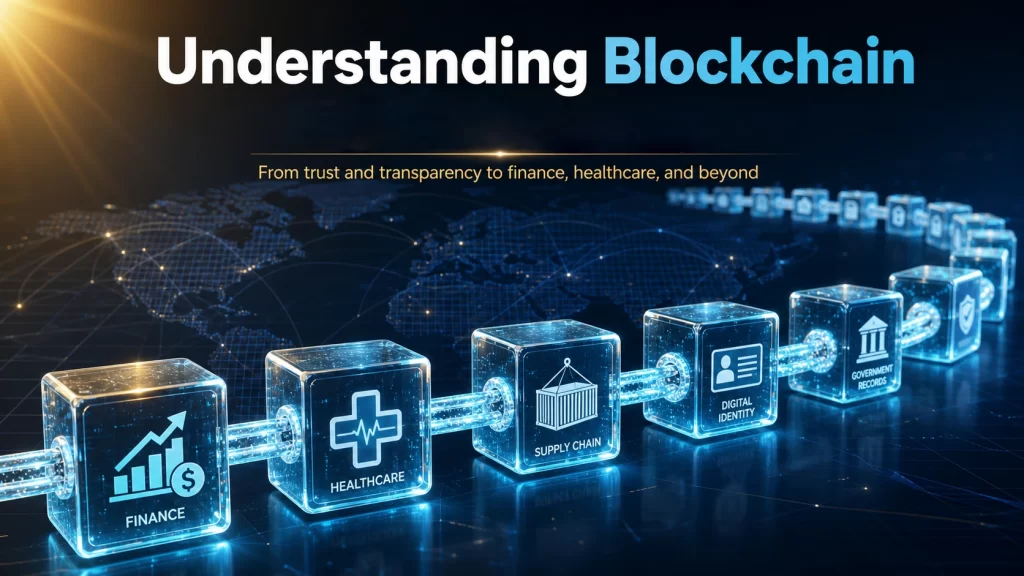
Blockchain is a type of distributed digital ledger that records information in a secure and transparent manner. To understand the concept, imagine a traditional account book used to record financial transactions. A blockchain performs a similar function but spreads copies of the ledger across a network of computers instead of storing it in a single location controlled by one organisation.
Information is stored in groups called “blocks”, with each block containing a collection of transactions or documents, along with a unique cryptographic code known as a ‘hash‘. Every new block links to the previous block, creating a chronological chain of records – hence the term blockchain.
Because every block connects to the one before it, changing information would require altering every subsequent block across the network, making unauthorised modifications extremely difficult. This structure creates a permanent and transparent record that multiple participants can verify.
However, blockchain is not a magical truth machine. While it can help ensure that records are not altered after entry, it cannot determine whether the original information is accurate. If someone enters incorrect information into the system, blockchain will preserve that information just as effectively as accurate data.
How Does Blockchain Work?
At its core, blockchain combines cryptography, networking, and consensus mechanisms to maintain a shared record of information. In most cases, the process follows these steps:
1- A Transaction Is Created
A user initiates a transaction by entering data, such as a request to send cryptocurrency, record asset ownership, or update a supply chain record.
2- The Transaction Is Broadcast
The information is shared with computers, often called ‘nodes’, that take part in the blockchain network.
3- Verification Takes Place
The network verifies whether the transaction meets the rules established by the blockchain – different chains use various methods to achieve this verification.
4- The Transaction Is Added to a Block
Once confirmed, the operation is grouped with other approved transactions into a block.
5- The Block Is Added to the Chain
The new block links to previous blocks through cryptographic hashes and is permanently added to the blockchain.
6- The Ledger Is Updated
Copies of the blockchain are distributed throughout the network, ensuring all participants share the same version of the record and creating a transparent, verifiable audit trail.
Key Features of Blockchain
Several characteristics distinguish blockchain from traditional databases.
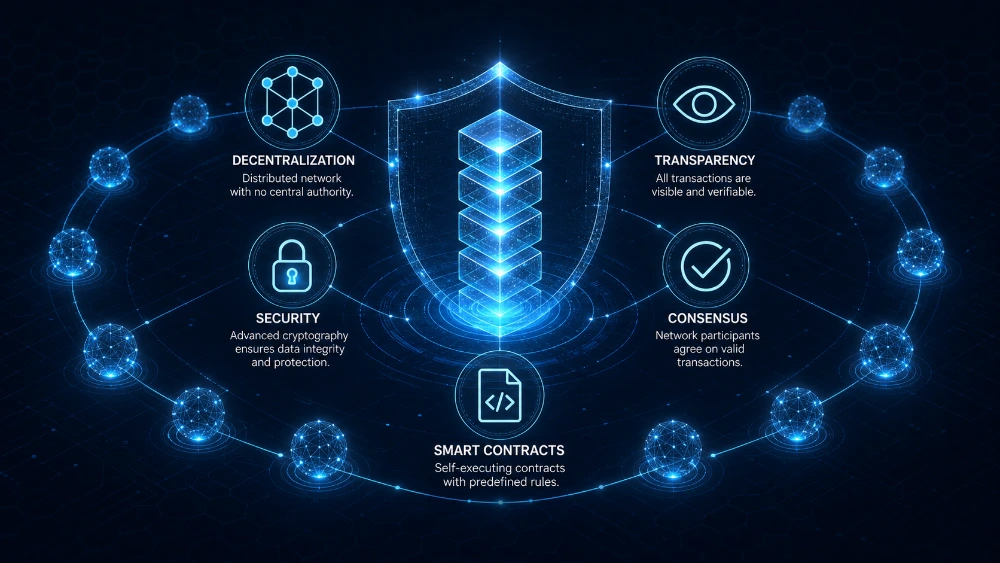
Decentralisation
Traditional databases are usually controlled by a central authority such as a bank, government agency, or corporation. In contrast, blockchain allocates authority among various contributors, reducing reliance on a single entity.
Transparency
Many blockchain platforms allow participants to view transaction histories. While user identities may remain pseudonymous, the transaction record itself remains visible and verifiable.
Immutability
Once data has been recorded and confirmed by the system, it cannot be easily altered; this resistance to change creates a permanent audit trail that can be reviewed at any time.
Security
Blockchain uses advanced cryptographic techniques to protect data and verify transactions.
Consensus Mechanisms
Blockchain networks use agreement processes to approve which transactions are valid, with common methods including:
- Proof of Work (used by Bitcoin)
- Proof of Stake (used by Ethereum).
Smart Contracts
Some blockchains support self-executing agreements known as ‘smart contracts’ – programmes that carry out actions when predetermined conditions are met. For instance, a smart contract could release payment to a supplier once a shipment arrives and is verified.

Toxic Gaslighting: How 3M Executives Convinced a Scientist the Forever Chemicals She Found in Human Blood Were Safe

Alcohol Causes Cancer, and Less Than 1 Drink Can Increase Your Risk − A Cancer Biologist Explains How

How Can Global Trade Contribute to World Peace?

How a Health Administration Degree Opens Doors to Leadership in Healthcare

Do Patients Who Suffer Heart Attack Have More Micro and Nanoplastic in Their Blood? New Study Assessed

Embedded Finance: How Contextual Banking Is Replacing Traditional Banks
Real-World Applications
Although blockchain is often associated with cryptocurrency, its potential benefits extend far beyond digital money.
Financial Services and Payments
Blockchain enables peer-to-peer transfers without requiring conventional financial intermediaries. Networks such as Bitcoin and Ethereum are amongst the most well-known examples of blockchain in action. Moreover, these systems often facilitate faster and lower-cost cross-border payments than traditional international bank transactions.
Supply Chain Management
Companies are increasingly using blockchain to track products from their origin to the final consumer, improving transparency, fighting counterfeit goods, and accelerating product recalls when safety issues arise.
Healthcare
Healthcare providers are exploring blockchain to manage patient records, prescription histories, and insurance claims. The technology may help authorised medical professionals access accurate records while maintaining privacy controls.
Education and Professional Credentials
Universities and certification entities may use blockchain to issue digital diplomas and qualifications. Through this, employers can verify credentials instantly without relying on lengthy manual verification processes.
Real Estate
Property transactions often involve multiple parties, extensive paperwork, and tedious cross-checking procedures. Blockchain could simplify transfers by providing a secure and transparent record of ownership.
Digital ID
Identity theft remains a growing concern worldwide. Blockchain-based identification systems will allow individuals to keep greater control over personal information while reducing dependence on centralised databases.
Government Services
Authorities are testing blockchain for land registries, public records, tax systems, and voting mechanisms. Although large-scale implementation remains limited, blockchain could improve transparency and reduce administrative inefficiencies.
Benefits of Blockchain
Increased Transparency
Because several participants share records, blockchain makes it easier to track and verify transactions.
Improved Security
With cryptographic protection and distributed storage, blockchain remains resistant to many forms of unauthorised tampering.
Greater Traceability
Organisations can track assets, products, and operations throughout their lifecycle.
Enhanced Resilience
Since multiple locations store data, blockchain networks are less vulnerable to single points of failure.
Financial Inclusion
Blockchain-based services may provide access to financial tools for people who lack traditional banking services, particularly in developing regions.
Challenges and Limitations of Blockchain
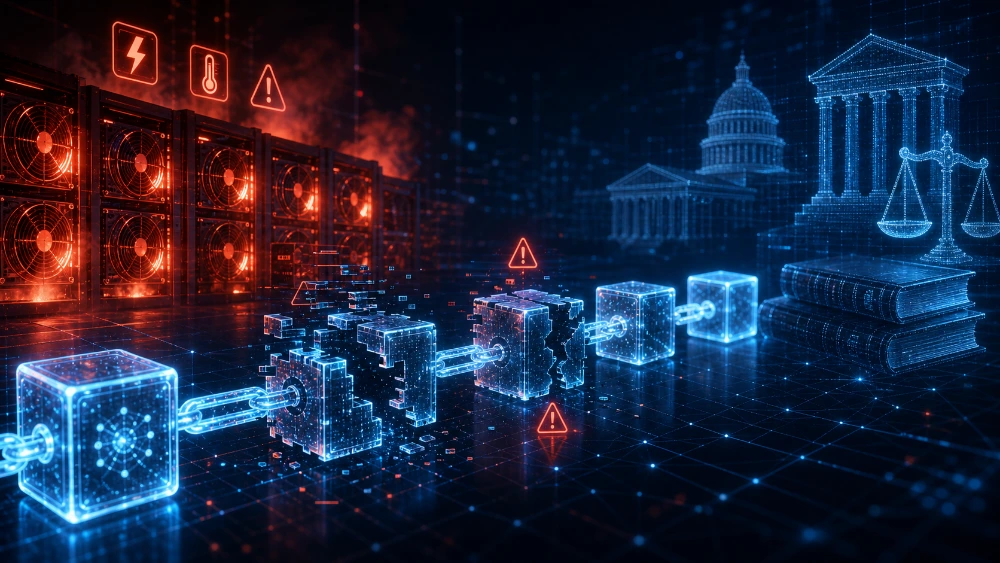
Despite its potential, blockchain still faces significant challenges.
Scalability
Many blockchain networks process transactions more slowly than traditional payment methods. As adoption increases, maintaining speed and efficiency persists as a critical test.
Energy Consumption
Some networks – in particular those using Proof of Work – demand significant computing power and electricity. Even though newer systems are becoming more energy-efficient, environmental concerns remain a significant point of discussion.
Data Accuracy
Blockchain secures information, but it cannot verify whether that information is correct. This challenge is often summarised as “garbage in, garbage out”.
Regulatory Uncertainty
Governments worldwide are still shaping legal frameworks for blockchain applications and digital assets. This evolving landscape creates doubt for businesses and investors.
Implementation Costs
Developing blockchain solutions requires specialised expertise, infrastructure, and investment. Often, a conventional database may still be the simpler and more cost-effective option.
Without a shadow of a doubt, blockchain represents a key innovation in digital record-keeping since the emergence of the internet. Its ability to create transparent, verifiable, and tamper-resistant records has attracted interest from organisations across almost every sector of the economy.
However, blockchain is not a universal solution. Like Artificial Intelligence, its integrity depends on the ethics of the individuals providing the data.