You’d be amazed to find out that the global skills and labour shortage is both real and manufactured. And that contradiction is the main point here. Yes, genuine structural forces are reshaping the workforce: demographic ageing, technological disruption, and the green transition are creating an authentic demand for skills that simply don’t exist yet in sufficient numbers.
But alongside these legitimate pressures sits a decade-long pattern of unwise employer behaviour:
● Cutting training budgets
● Inflating job requirements
● Refusing to pay market rates
● Poaching talent instead of growing it
And, as expected, this has deepened a crisis employers loudly blame on workers and education systems. The truth is messy, politically inconvenient, and calls for accountability from all sides.
The Numbers Are Hard to Ignore
Headline statistics from credible global surveys are striking. ManpowerGroup’s 2024 Talent Shortage Survey – one of the most cited annual studies of its kind – found that 75% of employers worldwide report difficulty filling roles, up from 36% in 2014 and 40% in 2018. That is a near-doubling in a decade, and it spans every major industry and geography.
According to the OECD’s 2024 Global Forum on Productivity Employer Survey, 70% to 85% of companies struggled to find the necessary skills in 2024, despite a slight decrease in labour market pressure. These shortages are most acute in Healthcare & Life Sciences (77%), Information Technology (76%), and Construction & Transport (76%).
By industry, the hardest-hit sectors are IT & Data, Engineering, Manufacturing & Production, and the top five soft skills employers cannot find are the following:
● Resilience & Adaptability
● Active Learning & Curiosity
● Reasoning & Problem-Solving
● Accountability & Reliability
● Collaboration & Teamwork
The fact that organisations struggle to unearth core human capabilities rather than technical ones complicates the argument that the shortage is simply a training issue with an easy fix.
Looking ahead, the consulting firm Korn Ferry’s landmark Global Talent Crunch study projects a deficit of over 85.2 million skilled workers globally by 2030, which could cost businesses around $8.5 trillion in unrealised revenue annually.
Meanwhile, the World Economic Forum’s Future of Jobs Report 2025, surveying more than 1,000 employers covering 14 million workers across 55 economies, estimated that 170 million new jobs will be created between 2025 and 2030, while 92 million will be displaced.
Those figures show a net gain of 78 million, but one demanding massive workforce transformation.
Critically, the WEF found that 39% of key skills required in the job market are set to change by 2030 and that 59% of the working population will need upskilling within that timeframe.
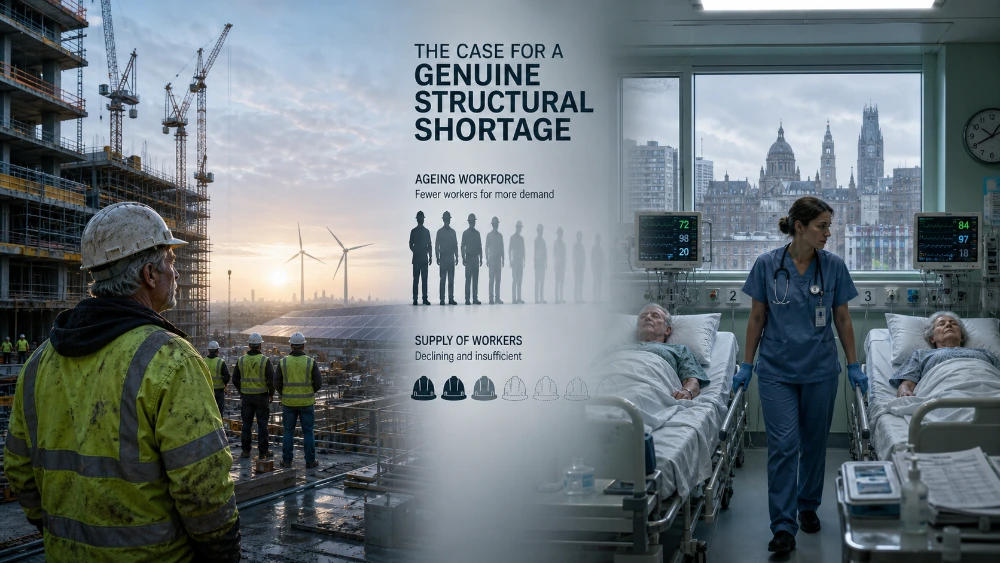
Not all the employer pain is self-inflicted. Several forces are producing authentic, hard-to-solve deficiencies that no amount of training budget has the power to resolve.
Demographic Ageing and Workforce Shrinkage
The OECD’s 2025 Can We Get Through the Demographic Crunch? Employment Outlook identifies ageing as one of the main drivers of labour market stress across developed economies. To illustrate, the old-age dependency ratio – the proportion of those over 65 relative to the working-age population – rose from 19% in 1980 to 31% in 2023. And it continues to climb. Globally, in around four years, one in six people will be over 60.
In skilled trades, 25% of craftsmen are expected to retire by 2030, creating a structural pipeline gap that apprenticeships alone cannot fill overnight.
In the UK building sector, the figures are stark. A May 2024 report by the Construction Industry Training Board (CITB) found that 251,000 extra workers will be required by 2028 to meet demand, and 31% of employers already cite finding suitable skilled staff as their single greatest challenge.
Meanwhile, UK data from Simply Business (between 2021 and 2024) highlights sharp declines in key trades over just four years:
● Welders fell by 10%
● Ground workers by 9%
● Plumbers by 9%
In healthcare, the figures are likewise grim. The US Health Resources and Services Administration reported a deficit of about 78,000 registered nurses (RNs) in 2025, easing only marginally to 63,000 by 2030. McKinsey & Company anticipated a shortfall of between 200,000 and 450,000 RNs needed for direct patient care in 2025. And by the end of 2025, data from the US Department of Health and Human Services (HHS) showed that the number of registered nurses increased by just 1%, compared with a 3% rise in demand, leaving a workforce gap of roughly 295,800 nurses – closely tracking McKinsey’s prediction.
Technological Disruption Has Outpaced Education Systems
Artificial Intelligence acceleration, automation, cloud computing, and green-energy advancement have created a genuine appetite for skills that formal education has not yet fully scaled up to deliver. IBM’s analysis notes that as AI and robotic streamlining evolve, traditional entry-level positions are disappearing and being replaced by roles that command more advanced technical capabilities from the outset. For its part, the WEF’s Future of Jobs Report 2025identifies big data as the fastest-growing skill need, with the demand for AI-related opportunities experiencing a 340% increase in job postings since 2020.
On the green economy side, the UK provides a vivid example of supply failing to meet demand. A 2024 Turner & Townsend report revealed that “green collar“ construction workers – insulation, heat pump, and solar installers – command wages of up to £134,000 per year, with London-based professionals earning £70 per hour, a 22% increase in a single year. These wage rates expose a direct market signal: the shortage is real, and it’s bidding up prices accordingly.
The Case Against Employers: Self-Inflicted Wounds

Here is where the narrative becomes less flattering for corporations. Much of what employers call a “skills shortage” is in fact a management failure, a wage problem, and a training abdication dressed up in the language of crisis.
Training Investment Has Collapsed
The most damning set of statistics comes from the UK’s Department for Education Employer Skills Survey 2024, covering over 22,000 employers. It found that British companies reduced their investment in professional development by £6 billion between 2022 and 2024, bringing total spending down to £53 billion – the lowest level recorded since the survey began in 2011. Training costs per employee dropped to £1,700 in 2024 from £1,960 in 2022, representing a 29.5% decline in real terms since 2011. Only 59% of UK firms provided any capability building at all in the past year, a decrease from 66% in 2017.
The New Economics Foundation’s analysis of this same dataset paints an even starker picture: total employer investment in skills declined 19% between 2011 and 2022, with larger businesses cutting budgets by 35% and the public sector by 38%. In the United States, companies reduced their training expenditure by 3.7% in 2024, with 14% of organisations (up from 11% the previous year) citing economic uncertainty as the primary driver.
The OECD’s own TUAC (Trade Union Advisory Committee) data indicates that government spending on active labour market policies is now at a 20-year low of 0.41% of GDP, and investment in coaching for unemployed workers has fallen by 30% since 2010, even as more than 34 million people remain jobless.
Based on research from Canada’s Conference Board, Ontario businesses were allocating an average of $700 per worker per year on workplace learning in 2010, compared with $1,200 in 1993 – a 42% decline over less than two decades. By comparison, employers in Sweden, the Netherlands, and France spent over $1,000 on each employee annually over that same timeframe.
The Wharton Verdict
For more than ten years, Professor Peter Cappelli of the Wharton School of Business at the University of Pennsylvaniahas been making a clear and uncomfortable argument. In his book, Why Good People Can’t Get Jobs, he dismantles the employer narrative with evidence, noting that the skills gap is not primarily a worker problem or an education problem; it is a management problem.
Cappelli identifies several specific corporate behaviours that create artificial shortages. First, companies have abandoned the practice of on-the-job training, preferring instead to seek workers who are already performing the same function they need at some other company. He calls it the “Home Depot view of the hiring process”: treating recruitment like buying a replacement part for a washing machine, demanding an exact fit or leaving the position unfilled. To illustrate this point, in 1979, most young US workers received two and a half weeks of practical instruction per year; by 1991, only 17% had any training whatsoever; by 2011, a mere 21% reported having received training in the past five years.
Second, employers have created catastrophically unrealistic job requirements. Cappelli estimates that between 10% and 20% of companies are not offering competitive salaries and then complain that they cannot attract talent. His point about wages is almost syllogistically simple: “You pay what it takes to get the people you need, and if wages have to go up, then so be it. You wouldn’t say there’s a shortage of diamonds. Diamonds are very expensive, but you can buy all the diamonds you want as long as you’re willing to pay.”
The Poaching Trap
When companies choose not to train their own personnel, they rely on poaching trained employees from competitors. But when everyone in an industry does this all at once, it creates an arms race that little by little strips coaching incentives from the entire sector. Here’s what it looks like in real life:
- Companies lose their staff development investment to poachers
- They cut training
- It begets more shortages
- Leads to more poaching
- Results in even less training
This situation is not a market failure but a collective action problem that employers created and perpetuate.
Degree Inflation: Adding Fake Barriers

LinkedIn data reveals “degree inflation” and “credential creep” as related and deeply pernicious problems. A Harvard analysis of 26 million job postings found striking gaps between employer credential demands and the actual education levels of people already doing those jobs successfully. For instance, in 2015, 67% of job ads for production supervisors required a university diploma, while only 16% of employed production supervisors actually held one. This means employers are screening out the vast majority of candidates who are, based on experience, capable of succeeding in the role.
Not long ago, LinkedIn’s own workforce metrics showed that one in five listings no longer specified a degree requirement, reflecting a growing employer recognition that skills-first hiring expands the talent pool by nearly 16 times. Yet the gap between rhetoric and practice remains enormous. To provide context, LinkedIn posts in 2025 were filled with bitter observations about entry-level job offers requiring “3-5 years of experience”, a mathematical impossibility that reflects corporate wish lists rather than genuine needs.
Sector-by-Sector Reality Check
As ever, the talent drought is not leaving all sectors equally parched, and the causes differ across industries.
| Sector | Shortage Reality | Primary Driver | Employer Culpability |
|---|---|---|---|
| Healthcare / Nursing | Severe and structural | Ageing population, burnout, retirement wave | Medium — low pay and burnout drive exits |
| Construction / Trades | Severe and worsening | Retirement wave, poor image, limited apprenticeships | High — perceptions of low pay, weak apprenticeship investment |
| IT / AI / Cybersecurity | Significant | Technology outpacing education | Medium-High — companies reject entry-level, cut training |
| Manufacturing | Mixed | Automation, ageing workforce | High — research shows 75% of plants have no hiring difficulty |
| Education / STEM Teaching | Real and growing | Poor pay, high stress, low incentives | Medium — largely a public-sector funding problem |
| Green / Clean Energy | Acute and structural | New sector, no existing talent pipeline | Low — genuinely new skill set, pipeline barely started |
In manufacturing, University of Illinois professor Andrew Weaver claims that three-quarters of US plants show no sign of hiring difficulties, contradicting industry surveys that claim 60–70% shortages. Weaver estimated the true upper bound of skill-gap-related vacancies to be 16-25%. His diagnosis is poor coordination between job seekers and employers, not a genuine shortage of capable people.
What Job Hubs Are Telling Us

With over 1 billion members and tens of millions of job postings, LinkedIn provides a useful, up-to-date lens on the state of the labour market. In its 2025 Workplace Learning Report, LinkedIn identifies skill-building as the number one organisational priority. But at the same time, it finds that only 36% of organisations are “career development champions” – companies that use multiple strategies to support employee growth. LinkedIn’s analysis shows that businesses with strong learning cultures enjoy 57% higher retention rates, 23% greater internal mobility, and 7% healthier management pipelines. Despite these benefits, only 15% of employees say their manager has helped them build a career plan in the past six months – a five-point drop from the previous year.
The contradiction becomes even more striking when it comes to retention: 90% of organisations continue to cut training budgets while reducing the entry-level roles that have traditionally served as pathways into the workforce.
This results in a vicious circle:
- Companies complain about staff shortages while advertising beginner positions that demand years of experience.
- They reject candidates who are not already performing the exact same job elsewhere.
- They also underinvest in training and career development programmes that could cultivate the talent they claim is missing.
In other words, many organisations appear to be searching for ready-made employees while investing less in the systems that develop them.
The Political Economy of “Skills Gap” Rhetoric
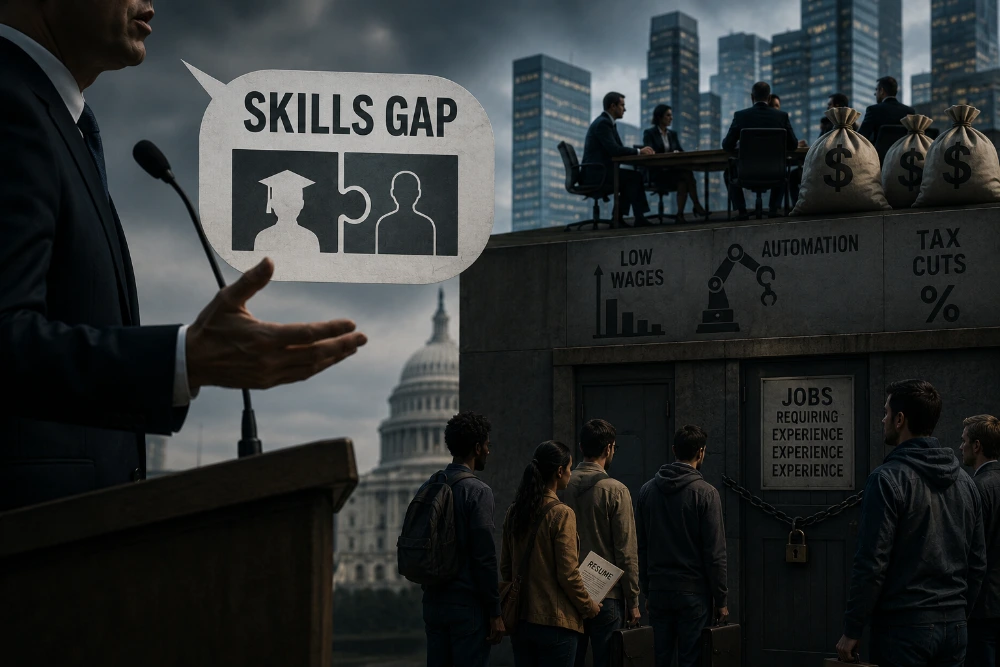
Economist Paul Krugman famously called the skills gap a “zombie idea” – one that “should have been killed by evidence but refuses to die”. The reason it persists, argued Academic Matters in a pointed 2020 analysis, has “less to do with ignorance than with power”. After decades of rising inequality and an eroding labour share of income, the skills gap narrative downloads blame onto workers and costs to the government. It takes the onus off employers to pay competitive wages, invest in training, and design inclusive hiring processes – instead framing labour market failures as the fault of inadequate staff.
The Economic Policy Institute has been even more direct, characterising the lack of qualified personnel as “a public relations tool for bad corporate citizens”, a mechanism through which executives lobby governments to subsidise the workforce development costs that businesses historically bore themselves. When JPMorgan CEO Jamie Dimon championed the “skills gap” in 2014, he also admitted that his bank had no evidence of one. The contradiction was jaw-dropping.
The loudest voices demanding government intervention to address a “skills crisis” were companies that had themselves slashed training budgets.
The German Contrast
Germany’s dual apprenticeship model – the Ausbildung – offers a powerful lesson in how to tackle skill shortages. By blending classroom instruction with paid, structured on-the-job training, it equips young people with workplace-ready skills across manufacturing, engineering, healthcare, and services before they enter the full labour market. The payoff is substantial: lower youth unemployment, a smoother path from school to work, and a stronger alignment between employer demand and talent capabilities.
Stark is the contrast with the Anglo-American approach. Where Germany treats workforce development as a shared investment between employers, government, and educational institutions, the UK and US have progressively shifted costs and responsibility while cutting public resources. The OECD recommends a universal training norm of 0.5% of GDP dedicated to upskilling by 2035. At the moment, government spending in this area sits at 0.1% of GDP – one-fifth of that target. Adecco’s 2025 white paper on global skills funding notes that replacing a departing employee amounts to up to 200% of their annual salary, while training an existing worker involves an average of just $1,000-$5,000.
The math is simple; the will is what is missing.
The Verdict: A Both/And Problem – But Not Equally So

The truth about skills and labour shortages is that both sides of the debate are correct, but not in equal measure.
The genuine case includes:
- Demographic ageing is draining experienced workers from healthcare, construction, and skilled trades.
- The unprecedented speed of technological change is creating real skill discrepancies.
- New sectors like green energy need pipelines that are not yet in place.
- Geographic mismatches also exist between worker locations and jobs.
The self-inflicted situation consists of:
- Decades of declining employer training investment.
- Widespread poaching cultures undermine incentives for companies to develop their own talent.
- Inflated and unrealistic job requirements often screen out capable candidates.
- Wage stagnation signals a “shortage” while actually reflecting a failure to price labour correctly.
- Degree inflation creates artificial barriers to entry for qualified candidates.
- And the deliberate transfer of training costs to governments and education systems while lobbying for more “skilled immigrants” as a cheaper alternative to domestic investment.
The LinkedIn 2025 Workplace Learning Report captures the perverse irony perfectly: organisations that invest in career development are more profitable, retain talent better, and lead in AI adoption. Despite this unambiguous ROI, trend lines point in the opposite direction. This is not a mystery but a short-term optimisation problem disguised as a structural crisis. Thus, the workers who most need training are, by design, the last in line to receive it.