“How Can Global Trade Contribute to World Peace” by Julia Croce, originally published on LSE Blogs (https://blogs.lse.ac.uk/businessreview/2026/07/02/how-can-global-trade-contribute-to-world-peace/), licensed under CC BY 4.0.
Increasing geopolitical tensions resulting from territorial disputes, political disagreements and economic competition have led management researchers in the fields of Business and Human Rights and Business for Peace to investigate corporate governance and business responsibility in relation to human rights, peace and international trade. In conflict settings, businesses can either fuel division among civilians or play a constructive role by facilitating peace mediation and increasing the ratification of business and human rights treaties.
The notion that business activities can contribute to peace, alongside the crucial role of trade in promoting peaceful relations and democratic values, warrants attention. Traditionally, Western macro-level analyses have referenced the philosophical theories of Immanuel Kant concerning the relationship between peace and trade. Nevertheless, there is no global consensus on deploying trade measures in pursuit of peace.
In a globalised economy, the emphasis is on the importance of multinational corporations and the cross-border value chains they cultivate and sustain. This influence of global value chains on trade policy outcomes at the international level is significant in shaping preferential trade agreements.
Trade policy outcomes across industries thus tend to be in line with the preferences of multinationals. And a growing number of preferential trade agreements with hard standards now regulate state compliance with international human rights principles, generating considerable potential to influence business’ behaviours. For instance, the Sanitary and Phytosanitary Measures (SPS Agreement) and the Technical Barriers to Trade (TBT) Agreement advance human right standards in food safety, corporate social responsibility and environmental protection. These agreements are designed to enforce voluntary commitments to co-ordinate market policies at a transnational level. Trade agreements can also exert influence through coercion when they enforce strict standards: they assign to countries a mandate to uphold specific human rights, and they provide the pecuniary advantages and institutional frameworks needed to reward and punish members’ behaviour.
Since 1947, trade liberalisation has advanced through multiple rounds of extended negotiations. The World Trade Organisation (WTO) is frequently mentioned as a leading example of an effective international institution. Its membership has increased significantly in recent decades, contributing to substantial growth in global trade. As shown in Figure 1, developing countries are now the most represented within the organisation, followed by the group of least developed countries which are also fragile and conflict-affected.
Figure 1. WTO Membership in a nutshell
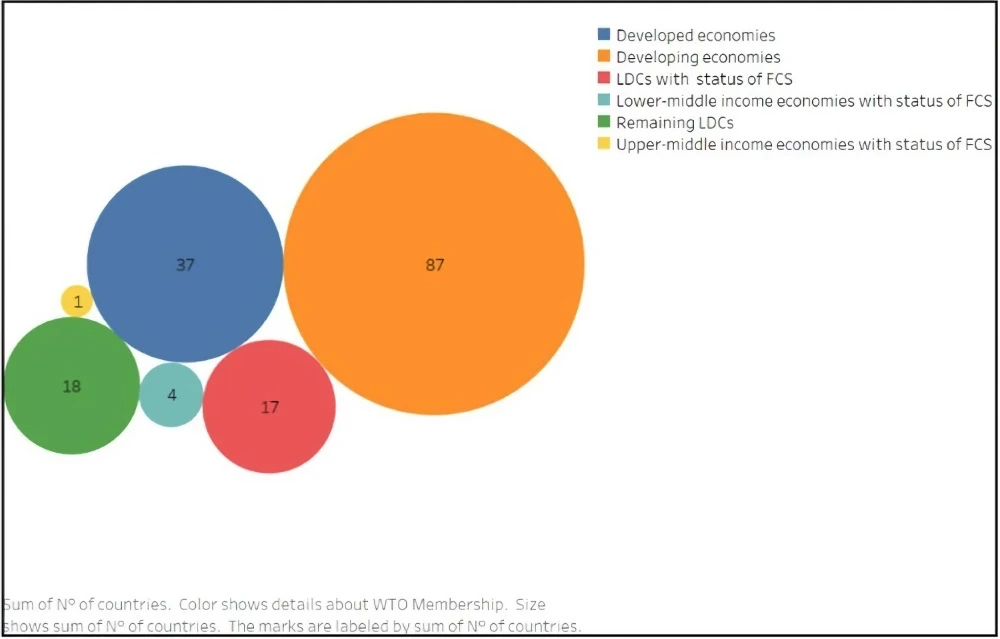
Source: Author’s analysis based on database of the World Bank and WTO; UNCTAD LDCs list.
Legend:
Developed economies = countries characterised by advanced infrastructure, high levels of industrialisation and efficient markets that are responsive to incentives and policies.
Developing economies = countries characterised by a gross domestic product (GDP) under 2000, and high rates of illiteracy, infant mortality and an inadequate material infrastructure.
LDCs = least developed countries, which are these low-income countries facing severe structural impediments to sustainable development.
FCS = fragile and conflict-affected states characterised by high levels of institutional and social fragility.
Lower-middle income economies = countries with a Gross National Income (GNI) per capita between $1,136 and $4,495.
Upper-middle income economies = countries with a GNI per capita between $4,496 and $13,935.
How Fragile States Can Benefit from WTO
Fragile and conflict-affected states are those facing economic and social difficulties including widespread poverty, slow economic growth, population displacement, human and capital flight, infrastructure damage and a high likelihood of conflict. Establishing a culture of peace in these countries involves the education for a peaceful resolution of conflict and maintaining peace; sustainable development (involving the eradication of poverty, the reduction of inequalities and environmental sustainability); human rights; gender equality; democratic participation; understanding, tolerance, and solidarity (among peoples, vulnerable groups and migrants within the country, and among countries).
Significant efforts are needed to encourage society to value peace, tolerance and mediation, as not all cultures naturally accept these ideals. In my research I discuss how Western countries are confronted with waves of civil unrest and a decline in human rights protection.
Peace-building strategies are often implemented without considering a regional approach, primarily because of insufficient data, knowledge and funding from the international community.
Figure 2 illustrates how peace is at risk globally in a significant number of WTO members, including fragile and conflict-affected states in African and developing countries in Central Asia and Latin America. It depicts regional peace patterns, distinguishing between wealthy areas characterised by stable and developed democracies, and conflict zones with unstable political, economic and civil systems.
According to the Global Peace Index (GPI), a composite index of 23 indicators including questions on ongoing conflicts, societal safety, and security and militarisation, countries affected by lower levels of peace such as Sudan have scores over 2.5. Meanwhile, countries with lasting peace, such as Australia or those in Northern Europe, have scores between 1.1 and 1.7.
Post-conflict reconstruction should be tailored to regional patterns of peace that also arise from WTO membership. It should set accordingly specific peace-enhancing goals that address needs of the country or region.
Figure 2. Mapping WTO members by Global Peace Index scores
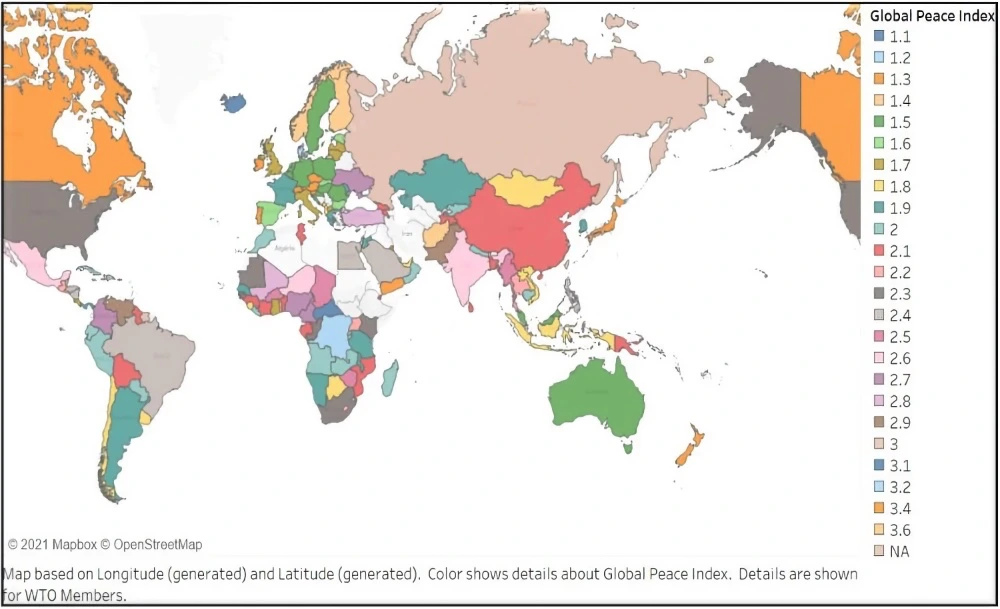
Source: Author’s analysis based on data of the WTO and GPI.
Legend:
1.1– 1.5: peaceful countries
1.6–1.9: moderately-peaceful countries
2–2.5: fragile and conflict-affected countries
2.5–3.6: violent and extremely-violent countries
Peace Diplomacy and Trade
The WTO holds a distinctive and advantageous position in promoting a culture of peace, particularly at the regional level and through the Trade for Peace Programme. WTO accession does not require any human rights or democracy criteria for membership.
However, most members have signed or ratified the two United Nations Covenants on Human Rights. The multilateral trading system provides mechanisms that allow national institutions to constrain minority interests by adhering to multilateral rules designed to serve broad public interests. In my new book, I examine these mechanisms and explore three approaches to supporting peace initiatives within the multilateral trading system.
Regional Trade Agreements and Human Rights
Businesses and regional trade agreements can encourage the transformation of society toward more peaceful ends by developing peacebuilding activities such as track-two diplomacy, cross-border trade and conflict-risk analysis. Numerous free-trade agreements contain provisions imposing human rights-related obligations. These are particularly common in agreements between the European Union and least developed countries, which are often former colonies.
Human rights provisions in free-trade agreements and regional trade agreements frequently include labour-related elements, such as those found in the International Labor Organization’s Declaration on Fundamental Principles and Rights at Work, signed in 1998. These hold substantial potential to enhance workers’ rights, safeguard environmental protection and initiate measures to defend vulnerable groups, including indigenous populations, against adverse effects of trade.
In trade-related legislation, the concept of solidarity originates from the collective practices of individuals globally, who have leveraged organisational models such as mutual benefit societies, trusts and co-operatives to consolidate their influence.
Ongoing discussions among WTO members are essential to further reinforce human rights and labour standards, clarify the significance of fundamental rights and assess their implications for international trade. Emphasising these aspects is crucial, as WTO processes significantly contribute to the legitimacy of democratic societies and can serve to strengthen democratic rights.
Reinforcing Models for WTO Members Experiencing Fragility and Conflict
Establishing strong procedures aimed at conflict prevention and peacebuilding is particularly significant for reducing tension and violence among countries pursuing WTO membership, such as Iraq, Somalia, South Sudan and Syria. The WTO’s measures to advance peace in fragile and conflict-affected countries should encompass structural harmonisation and nation-building strategies.
These complex challenges underscore the importance of demonstrating the role of trade in achieving sustainable peace. By joining the multilateral trading system, fragile and conflict-affected countries should acknowledge not only the economic, political and social advantages but also the capacity of trade to establish and secure peace domestically.
Take Somalia’s progress towards WTO accession. The country has a long history of civil conflict and is heavily dependent on the export of mineral resources. The WTO has collaborated with the government to promote peace and security by effectively managing natural resources, focusing on reducing social and economic tensions related to the charcoal trade. It is crucial that further efforts be made to ensure environmental peacebuilding, given the country’s vulnerability to extreme weather conditions and resulting cycles of famine.
Developing A Global Diplomatic System to Foster Peace Through Trade
The WTO plays a key role in fostering multistakeholder diplomacy and helping governments and businesses reach consensus, especially in unstable or conflict-prone places. With governments increasingly turning to unilateral measures like supply chain due-diligence requirements or the implementation of human rights and peacebuilding measures, the potential of free-trade agreements to be used as sites of economic diplomacy in the goal of sustainable development is highly relevant.
While domestic issues remain crucial for rebuilding peace, WTO members can encourage a new vision of peaceful coexistence – one based on mutual recognition, compromise and respect for jointly agreed rules. As global economics change quickly, concerns over the “erosion of democracy” highlight the need for stronger international diplomacy focused on peace.
Due to its magnitude and public impact, the US–China trade war, which escalated in 2018, serves as an example for testing theories about the relationship between trade and peace.
That year, the Trump administration imposed higher tariffs on selected Chinese goods; China responded with tariffs on over half of its American imports. This standoff drew attention because both countries are the largest trading partners and economies. The issue was politicised during the American presidential campaign in 2016 and Donald Trump’s early presidency.
As economic reforms in China slowed, the WTO lost influence, and China’s trade surplus with America soared. Mr Trump further politicised the dispute and solidified the partisan dimension of US–China relations. In 2026 Mr Trump’s mission in China reinforced the strong commercial and ideological ties between the two countries. The rituals and rhetoric used during the visit recalled the Kantian peacebuilding approach, centred on economic prosperity and trade relations; international security is seen as the product of a stable and developed global economy. This approach is also used to justify military intervention in the Middle East by America and Israel.
The Black Sea Grain Initiative – backed by UN Trade and Development and established to secure shipments of grain and fertiliser from Ukrainian ports after Russia’s invasion – also highlights the role of trade as a foreign policy tool.
Such developments show that trade can support the interests of various actors, whether aggressors, defenders or peacemakers. Disagreements over the Ukraine conflict do not necessarily signal the end of effective multilateralism in organisations like the EU or NATO; instead, they could mark a renewed focus on regional co-operation within a global framework, offering fresh approaches to collaboration. By using countries’ economic leverage for political purposes, diplomatic efforts within the WTO should aim to align states’ interests and build both moral and political consensus, ultimately promoting trade as an instrument for advancing peace.
This article is based on the author’s book Peace, Business, and Democracy: Corporate Responsibility in Peace and Governance, published by Routledge.
About the author Julia Croce

Julia Croce is an academic specialising in human rights and business ethics. Her work focuses on the growing responsibility of businesses in defining and respecting peace and democracy in fragile and conflict-affected societies. In 2024, she was honoured with the prestigious Prix William Rappard. She is a research fellow at the Albert Hirschman Centre on Democracy at the Geneva Graduate Institute. Prior to starting her academic career, she served the United Nations, contributing to initiatives that aimed to enhance sustainable trade policies. Julia received a PhD in Management from the University of Geneva, Switzerland.