For over a century, banking was defined by the “destination” model. To illustrate this point, if a consumer required a loan, he visited a physical branch; if a merchant needed capital, she navigated a fragmented landscape of bank portals and credit bureau checks. Although there’s nothing wrong with this approach – we are all accustomed to it – it is inherently friction-heavy, requiring users to exit their primary workflow to engage with a separate financial institution.
Things change though. Today, we are witnessing the disintermediation of the bank branch through the rise of Embedded Finance. This is more than a technological upgrade; it is a structural transformation of the financial value chain. Thus, we have moved from destination banking to Contextual Banking, where credit and payment vehicles are integrated directly into non-financial platforms when required.
In this new paradigm, financial services are no longer a standalone task but an invisible layer in the software stack.
The $7 trillion “Silent Revolution”

The scale of this shift indicates a fundamental reconfiguration of the global economy. According to data from Bain & Company, embedded financial services accounted for $2.6 trillion in transaction value in the United States alone in 2021. By 2026, this sector is projected to exceed $7 trillion in total payment volume, capturing over 10% of the US total.
This growth is unrelenting because finance has transitioned from a business model unto itself to a “crucial component of the software framework”. For platforms, the revenue opportunity is on track to surge from $22 billion to $51 billion by 2026. Of course, this isn’t only about transaction value but about the identity of the companies driving it.
“Demand will grow because the proposition promises to improve customer experiences and financial access, along with providing cost-reduction and risk-reduction benefits.” Bain & Company.
The “Angela Strange” Thesis: Every Company is a FinTech
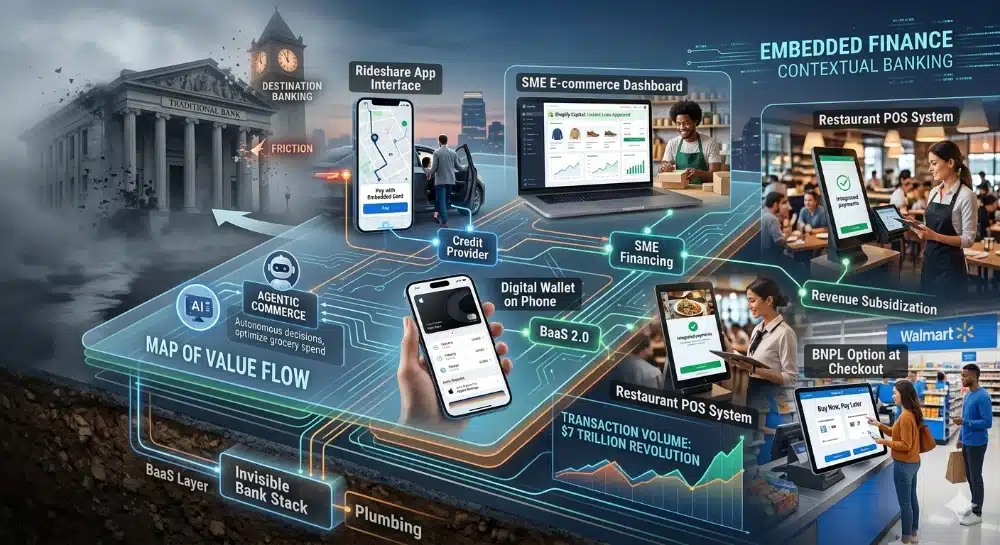
Venture capitalist Angela Strange famously asserted that “every company will be a FinTech company”. To an industry strategist, this is an argument about unit economics. By embedding financial services, brands can dramatically lower Customer Acquisition Costs (CAC) and increase the Lifetime Value (LTV) of their users. A prime example of this logic is the restaurant platform Toast.
Toast uses payment revenue to subsidise the cost of its hardware, lowering the barrier to entry for new customers while securing long-term ecosystem “stickiness”. When a brand manages the flow of funds, the switching costs for the customer become exponential.
Another example is Starbucks, which serves as the quintessential “closed-loop” powerhouse.
With approximately 30% of its US transactions occurring through its proprietary app, the company has successfully bypassed established payment rails to gain three critical strategic advantages:
1- Reduction of Economic Rents: By moving customers to a closed-loop system, Starbucks avoids hefty transaction charges paid to credit card networks.
2- Contextual Data Ownership: Unlike traditional banks relying on historical snapshots, Starbucks tracks purchasing habits with pinpoint accuracy, enabling hyper-personalised rewards that drive retention.
3- Capital Liquidity: The billions of dollars held in “stored value” within the app function as a zero-interest loan from the consumer, providing a massive pool of cash for operations.
Real-Time Data vs The Ghost of Credit Scores
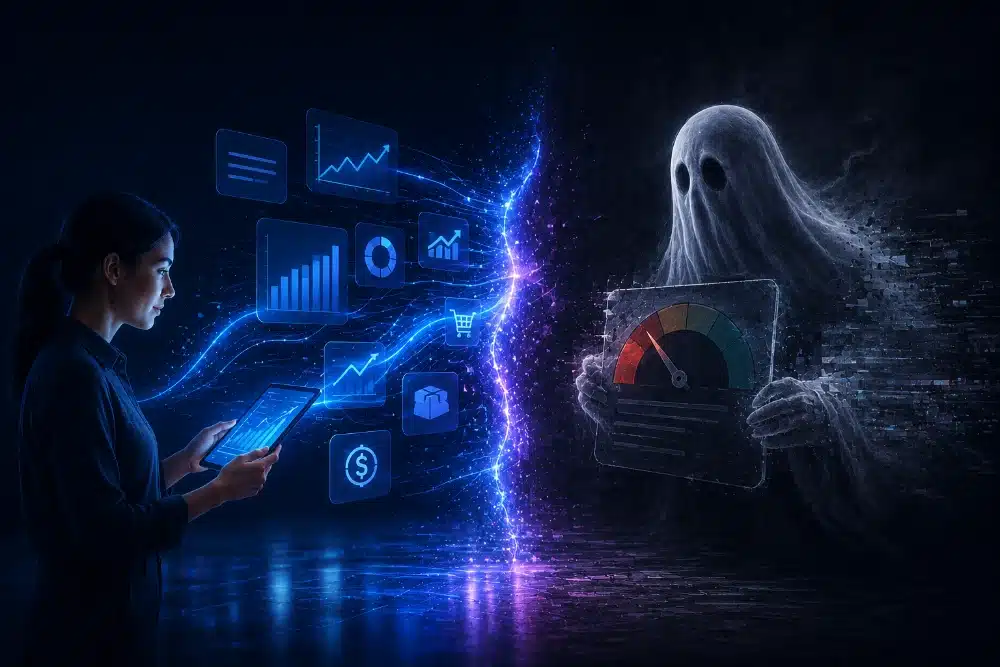
Embedded finance democratises access to funding by replacing the “ghost” of outdated credit scores with up-to-the-minute behavioural information. Case in point: traditional institutions often reject Small-to-Medium Enterprises (SMEs) and gig workers because they lack the collateral or historical data required by legacy underwriting models.
Looking at Shopify Capital, it has disrupted this space by using a merchant’s actual store performance – sales velocity, inventory turnover, customer engagement – to underwrite loans. This “Business-in-a-Box” model offers a distinct advantage: the “repay as you sell” mechanism.
Repayments are automated as a fixed percentage of daily sales, aligning the cost of capital directly with the merchant’s cash flow. On slow days, the payment is smaller. During peak seasons, the higher repayment volume ensures the debt is cleared faster without straining the business.

How Can Global Trade Contribute to World Peace?

Embedded Finance: How Contextual Banking Is Replacing Traditional Banks

The “Invisible Employee” Trap: 5 Surprising Realities of Proximity Bias in the Hybrid Era

The Truth About Skills & Labour Shortages: Real Crisis or Corporate Fiction?
Understanding Blockchain and Its Real-World Applications

How to Make Big Financial Changes in Just 30 Days and Build Momentum
The Apple Revolution: From Payments to BaaS 2.0

Cupertino behemoth Apple provides the most sophisticated roadmap for the transition from a hardware giant to a personal neobank. Its expansion has been a masterclass in sequential ecosystem capture:
- Apple Pay (2014): The “wedge” that conquered the digital and NFC (Near Field Communication) checkout experience.
- Apple Card (2019): A credit product built for financial health, featuring real-time interest estimation and Daily Cash rewards.
- Apple Savings (2023): Reached an unprecedented $10 billion in deposits within months of launch through the frictionless auto-deposit of rewards.
The recent transition of the Apple Card portfolio from Goldman Sachs to JPMorgan Chase signals the arrival of the “BaaS 2.0” model. While Goldman Sachs struggled with the unit economics of a high-volume, no-fee product, Chase provides the operating leverage and scale of a global tier-one bank. For Chase, this is a “demographic on-ramp” to younger households, while Apple retains the high-margin customer relationship.
“We designed Apple Card with users’ financial health in mind, and it’s rewarding to see our more than 12 million customers using its features to make healthier financial decisions.” Jennifer Bailey, Apple’s VP of Apple Pay and Apple Wallet.
The Shadow Side: Complexity and the FDIC Gap
Despite the seamless user experience, the fragmentation of the financial value chain introduces significant risks that consumers often overlook.
The FDIC Protection Gap
Experts argue that a primary concern is the safety of funds stored on non-bank platforms. While many apps claim “pass-through” FDIC insurance, this protection is conditional on perfect record-keeping by the platform. If an application fails and its funds are “commingled”, identifying the individual owner of each dollar can become a legal quagmire. Also, in the event of platform insolvency, consumers may face delays, leaving their money tied up in bankruptcy court for months.
“Phantom Debt” and Data Harvesting
The rise of Buy Now, Pay Later (BNPL) has created a layer of “phantom debt” that traditional credit models cannot see. Because BNPL loans are often not reported to credit bureaus, users can engage in “loan stacking” (taking out multiple simultaneous loans). Notably, BNPL liabilities now account for 28% of total unsecured debt for the 18-24 demographic. Furthermore, the Consumer Financial Protection Bureau (CFPB) has raised alarms about data harvesting. When financial data is merged with geographic location and biometric information, it creates a loss of privacy that legacy banking regulations were designed to prevent.
The Era of Agentic Commerce

We are moving beyond simple app integrations. In the not-too-distant future of Agentic Commerce, AI-driven advisors – not humans – will make autonomous financial decisions. Consider a “Walmart OnePay” agent: an AI assistant that automatically optimises your grocery spend by cross-referencing your bank balance against upcoming bills and seasonal discounts. It executes the transaction and chooses the optimal financing method without the user ever opening a wallet. As we move towards these autonomous ecosystems, the “regular banking system” faces an existential threat of being relegated to the plumbing.
Embedded finance is turning traditional banks into the invisible utility of the global economy. While this shift offers unparalleled convenience and inclusion for SMEs and underserved consumers, it requires a new level of consumer vigilance. But consider that as banking disappears, the burden of accountability shifts. We must look past the “frictionless UI” to understand where our money is held, who is harvesting our data, and who is ultimately responsible when the software fails.
Is the era of destination banking over? If so, the era of responsibility has just begun.